

 Doctors Andrew, Tina, and Laura Frangella are an award-winning brother-sister team of dental experts who strive for excellence to give their patients perfect smiles. Many years of education combined with countless hours of hands-on experience equals results, knowledge, and skills you can count on. Dentistry – the perfect fit for the Frangellas! Why did they all choose to improve smiles? Dr. Andrew decided dentistry was for him after finishing his first year of undergraduate school. He is a graduate of New York University College of Dentistry class of 2005 and received his bachelor’s degree at Lehigh University Bethlehem in 1999.
As part of his commitment to continuous learning, he was awarded prestigious Fellowships from the Academy of General Dentistry and from the world-renowned Misch International Implant Institute in association with Temple University and with the International Congress of Oral Implantologists. Dr. Andrew is the recipient of the 2005 Robert A. Sussman Memorial Award – given to doctors who show clinical excellence in operative dentistry and humanitarian value in patient care.
When he isn’t improving smiles for a lifetime, he educates other dental professionals about emerging technologies in dentistry. Dr. Tina always knew she wanted to work in the health care field. At the end of high school and at the start of college, she worked in her uncle’s dental office. She loved the environment and this wonderful learning experience helped her realize that she wanted to be a dentist too.
She earned her Doctor of Dental Surgery Degree from the University at Buffalo School of Dental Medicine. Afterwards, Dr. Tina finished her general practice residency at Nassau University Medical Center. She obtained a bachelor’s degree in biology from Adelphi University in Nassau County, NY.
Another two educational milestone were her residency at the Albert Einstein College of Medicine in IV conscious sedation and her training in advanced restorative dentistry and progressive orthodontics. She particularly enjoys whitening and straightening smiles as an Invisalign® specialist in midtown NYC.
Just like her sister, Dr. Laura became immersed in dentistry at her uncle’s practice. She considered both the dental and medical fields, but chose dentistry because she enjoys working with her hands to enhance smiles and forming positive relationships with patients.
Dr. Laura graduated with honors from the University at Buffalo School of Dental Medicine. During her studies, she was honored by the American College of Prosthodontics for outstanding achievement in the study of prosthodontics (replacement teeth). Then, Dr. Laura completed her general dentistry residency at Nassau University Medical Center. She received her Bachelor of Science degree in biology at Lehigh University. It makes Dr. Laura feel good inside to provide complete smile makeovers with dental implants in Manhattan.
If you’ve searched for “Central Park Dentistry” or “Manhattan Dentist,” we’re glad you’ve found us! Give us a call today and join our dental family – we’d love to help you smile more!]]>
Doctors Andrew, Tina, and Laura Frangella are an award-winning brother-sister team of dental experts who strive for excellence to give their patients perfect smiles. Many years of education combined with countless hours of hands-on experience equals results, knowledge, and skills you can count on. Dentistry – the perfect fit for the Frangellas! Why did they all choose to improve smiles? Dr. Andrew decided dentistry was for him after finishing his first year of undergraduate school. He is a graduate of New York University College of Dentistry class of 2005 and received his bachelor’s degree at Lehigh University Bethlehem in 1999.
As part of his commitment to continuous learning, he was awarded prestigious Fellowships from the Academy of General Dentistry and from the world-renowned Misch International Implant Institute in association with Temple University and with the International Congress of Oral Implantologists. Dr. Andrew is the recipient of the 2005 Robert A. Sussman Memorial Award – given to doctors who show clinical excellence in operative dentistry and humanitarian value in patient care.
When he isn’t improving smiles for a lifetime, he educates other dental professionals about emerging technologies in dentistry. Dr. Tina always knew she wanted to work in the health care field. At the end of high school and at the start of college, she worked in her uncle’s dental office. She loved the environment and this wonderful learning experience helped her realize that she wanted to be a dentist too.
She earned her Doctor of Dental Surgery Degree from the University at Buffalo School of Dental Medicine. Afterwards, Dr. Tina finished her general practice residency at Nassau University Medical Center. She obtained a bachelor’s degree in biology from Adelphi University in Nassau County, NY.
Another two educational milestone were her residency at the Albert Einstein College of Medicine in IV conscious sedation and her training in advanced restorative dentistry and progressive orthodontics. She particularly enjoys whitening and straightening smiles as an Invisalign® specialist in midtown NYC.
Just like her sister, Dr. Laura became immersed in dentistry at her uncle’s practice. She considered both the dental and medical fields, but chose dentistry because she enjoys working with her hands to enhance smiles and forming positive relationships with patients.
Dr. Laura graduated with honors from the University at Buffalo School of Dental Medicine. During her studies, she was honored by the American College of Prosthodontics for outstanding achievement in the study of prosthodontics (replacement teeth). Then, Dr. Laura completed her general dentistry residency at Nassau University Medical Center. She received her Bachelor of Science degree in biology at Lehigh University. It makes Dr. Laura feel good inside to provide complete smile makeovers with dental implants in Manhattan.
If you’ve searched for “Central Park Dentistry” or “Manhattan Dentist,” we’re glad you’ve found us! Give us a call today and join our dental family – we’d love to help you smile more!]]>
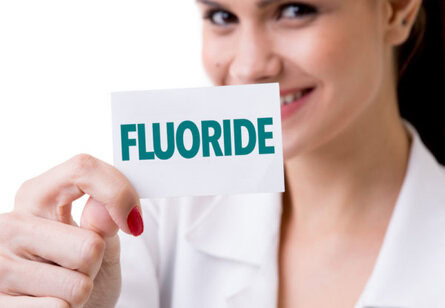 If you are someone who looks to protect the health of your teeth there are many surprising sources of fluoride that can help achieve the daily recommended allowances. If you are someone that hates fluoride and wants to avoid it then these sources may also be of interest. The daily recommended ingested allowance of fluoride is 3 mg for female adults 19 years or older and 4 mg for male adults 19 years or older with maximum allowances of 10 mg in both genders. The amount of fluoride varies along with the amount of the substance in which it is found. You are probably saying to yourself, “keep this short and simple, just give me examples of the sources”…… and here they are:
Oral Hygiene Product Sources for Fluoride
- A strip of toothpaste with .24% sodium fluoride covering the length of the brush: .75-1.5 mg of fluoride
- 10 ml of Mouthrinse with .05% sodium fluoride: 2 mg of fluoride
Water Sources for Fluoride
- Water NYC, 1 liter: .7 mg fluoride
- Dasoni, 1 liter: .07 mg fluoride
- Poland Springs, 1 liter: .10 mg fluoride
- Aquafina, 1 liter: .05 mg fluoride
Food Sources for Fluoride
A few foods contain significant amounts of fluoride. Since it is found in seawater, ocean fish contain fluoride. It is also concentrated in tea leaves. The approximate fluoride content for some common foods:- Tea, 3.5 ounces: 0.1-0.6 mg fluoride
- Canned sardines with bones, 3.5 oz: 0.2-0.4 mg fluoride
- Fish without bones, 3.5 oz: 0.01-0.17 mg fluoride
- Chicken, 3.5 oz : 0.06-0.10 mg fluoride
- Raisins, 1.5 oz: .101 mg fluoride
- Baked Potatoe, .3 lb: .078 mg fluoride
- Lamb, 6 oz: .054 mg fluoride
- Table wine, 26.4 fl oz: 1.150 mg fluoride
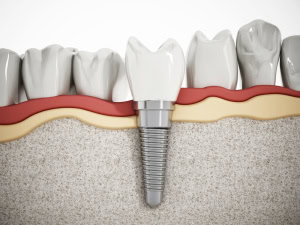 Every so often I like to take a step back and evaluate the progress made in the area of dental implants and how it has changed in my practice. Over the last few years I have been placing a dental implant (Biohorizon) with improved design features from past implants. These improved design features have minimized a few of the complications associated with dental implants in my practice.
One of the complications that has be reduced greatly is peri-implantitis. Peri-implantitis is the inflammation of bone and gums around dental implants in patients. With the added Laser-lok design feature on the Biohorizon implants, tissue stays firm and attached around the implant fixture. Therefore, reducing the likelihood of peri-implantitis developing.
The biggest advantage I have noticed because of improved implant design is the increased rigid fixation I attain while placing the Biohorizon dental implant. This has allowed me to place the majority of dental implants at the time of tooth extraction. Anyone familiar with the traditional healing process for dental implants is aware that a dental implant procedure from start to finish can take 6-12 months. This includes multiple surgical and post operative visits. Today, with the immediate placement of an implant during extraction, that time-frame has been reduced to 3-6 months start to finish. This has not only reduced the healing time, but reduced the amount of surgery and visits a patient needs to complete the process. The overall satisfaction from the procedure has improved tremendously.
These improvements have made a significant impact in the treatment of my patients with dental implants today. I look to forward to further advancements and sharing them with you as we progress.
Remember to keep those implants clean!!! (T-32 Ultrasonic Rechargeable Toothbrush).]]>
Every so often I like to take a step back and evaluate the progress made in the area of dental implants and how it has changed in my practice. Over the last few years I have been placing a dental implant (Biohorizon) with improved design features from past implants. These improved design features have minimized a few of the complications associated with dental implants in my practice.
One of the complications that has be reduced greatly is peri-implantitis. Peri-implantitis is the inflammation of bone and gums around dental implants in patients. With the added Laser-lok design feature on the Biohorizon implants, tissue stays firm and attached around the implant fixture. Therefore, reducing the likelihood of peri-implantitis developing.
The biggest advantage I have noticed because of improved implant design is the increased rigid fixation I attain while placing the Biohorizon dental implant. This has allowed me to place the majority of dental implants at the time of tooth extraction. Anyone familiar with the traditional healing process for dental implants is aware that a dental implant procedure from start to finish can take 6-12 months. This includes multiple surgical and post operative visits. Today, with the immediate placement of an implant during extraction, that time-frame has been reduced to 3-6 months start to finish. This has not only reduced the healing time, but reduced the amount of surgery and visits a patient needs to complete the process. The overall satisfaction from the procedure has improved tremendously.
These improvements have made a significant impact in the treatment of my patients with dental implants today. I look to forward to further advancements and sharing them with you as we progress.
Remember to keep those implants clean!!! (T-32 Ultrasonic Rechargeable Toothbrush).]]>
Lorem ipsum dolor sit amet, consectetuer adipiscing elit. Aenean commodo ligula eget dolor. Aenean massa. Cum sociis natoque penatibus et magnis dis parturient montes, nascetur ridiculus mus. Donec quam felis, ultricies nec, pellentesque eu, pretium quis, sem.
Nulla consequat massa quis enim. Donec pede justo, fringilla vel, aliquet nec, vulputate eget, arcu. In enim justo, rhoncus ut, imperdiet a, venenatis vitae, justo. Nullam dictum felis eu pede mollis pretium. Integer tincidunt. Cras dapibus. Vivamus elementum semper nisi. Aenean vulputate eleifend tellus. Aenean leo ligula, porttitor eu, consequat vitae, eleifend ac, enim.
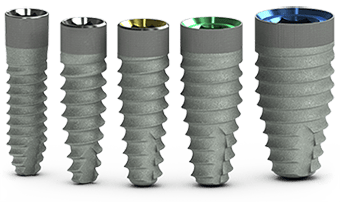 As a clinician that places and restores dental implants, the Biohorizon internal tapered dental implant is my favorite dental implant to place in the right situation. Each dental implant site requires careful evaluation and can present with difficult obstacles for success. Therefore, clinicians need to be versatile in the type of implant they select because certain dental implants will perform better in specific situations. With the hundreds of different types of dental implants out there, choices can be daunting for a clinician.
There are several factors as to why I chose Biohorizon dental implants in the right situation. The biggest benefit I see from Biohorizon implants is the Laser-Lok microchannels. In my opinion, the tissue response and attachment that Biohorizon provides is most similar to a natural tooth compared to all the dental implants I have come across. One of my main goals as a Implantologist is to replicate nature and Biohorizon helps achieve those aesthetics. Biohorizon internal tapered dental implants carry a lifetime warranty . I place hundreds of dental implants a year, aside from research and studies on the Biohorizon implants, the warranty gives me confidence that the company believes and stands by its product. The final factor that causes me to lean heavy towards this dental implant is the ease of placement and restoration. Surgically it is a very simple system with very high success rates nationwide. Prosthetically, Biohorizon is a well know dental implant within the laboratory circles that the lab technicians are familiar.]]>
As a clinician that places and restores dental implants, the Biohorizon internal tapered dental implant is my favorite dental implant to place in the right situation. Each dental implant site requires careful evaluation and can present with difficult obstacles for success. Therefore, clinicians need to be versatile in the type of implant they select because certain dental implants will perform better in specific situations. With the hundreds of different types of dental implants out there, choices can be daunting for a clinician.
There are several factors as to why I chose Biohorizon dental implants in the right situation. The biggest benefit I see from Biohorizon implants is the Laser-Lok microchannels. In my opinion, the tissue response and attachment that Biohorizon provides is most similar to a natural tooth compared to all the dental implants I have come across. One of my main goals as a Implantologist is to replicate nature and Biohorizon helps achieve those aesthetics. Biohorizon internal tapered dental implants carry a lifetime warranty . I place hundreds of dental implants a year, aside from research and studies on the Biohorizon implants, the warranty gives me confidence that the company believes and stands by its product. The final factor that causes me to lean heavy towards this dental implant is the ease of placement and restoration. Surgically it is a very simple system with very high success rates nationwide. Prosthetically, Biohorizon is a well know dental implant within the laboratory circles that the lab technicians are familiar.]]>
osteoporosis and osteopenia often ask if they are candidates for dental implants. My short answer is dental implants result in a better quality of life for osteoporotic women. There are studies that show women  with osteoporosis and dental implants have higher overall satisfaction with their lives as opposed to living with false teeth (dentures) or no restorations at all. The dentist placing implants needs to take into consideration the simple fact studies show overall satisfaction with dental implants in osteoporotic women and then weigh that against the risk indicators that could affect the long term success of dental implant restorations. The causality between oral bone loss and systemic bone loss (osteoporosis or osteopenia) has not be proven, but there is evidence that a relationship exists between the two diseases. Undoubtedly, dental implants can be successful initially in the dental patient with osteoporosis, its the long term success that is uncertain.
In our practice we carefully evaluate the osteoporotic patient and determine the likelihood they will have a high percentage of success with initial dental implant placement and restoration. We do this with an extensive screening of the patients medical history and a CT scan to measure the quality and amount of bone in the oral cavity. At Frangella Dental, 98% early surgical success is what we strive for with each patient. Because the CT scan can evaluate the quality and amount of bone, we can categorize the surgical site into a specific type of bone. Through extensive clinical studies from the past, we can use this input and inform the patient with a range in percentage of early dental implant success before we begin the procedure.
When dental implants are successful with our patients, we then give strict guidance on the proper oral hygiene maintenance. With close supervision through periodic dental visits and proper oral hygiene maintenance, our osteoporotic patients with dental implants have experienced overall satisfaction and achieved long term success. In our practice, the overall satisfaction of osteoporotic patients with dental implants far outweighs the potential risks.]]>
with osteoporosis and dental implants have higher overall satisfaction with their lives as opposed to living with false teeth (dentures) or no restorations at all. The dentist placing implants needs to take into consideration the simple fact studies show overall satisfaction with dental implants in osteoporotic women and then weigh that against the risk indicators that could affect the long term success of dental implant restorations. The causality between oral bone loss and systemic bone loss (osteoporosis or osteopenia) has not be proven, but there is evidence that a relationship exists between the two diseases. Undoubtedly, dental implants can be successful initially in the dental patient with osteoporosis, its the long term success that is uncertain.
In our practice we carefully evaluate the osteoporotic patient and determine the likelihood they will have a high percentage of success with initial dental implant placement and restoration. We do this with an extensive screening of the patients medical history and a CT scan to measure the quality and amount of bone in the oral cavity. At Frangella Dental, 98% early surgical success is what we strive for with each patient. Because the CT scan can evaluate the quality and amount of bone, we can categorize the surgical site into a specific type of bone. Through extensive clinical studies from the past, we can use this input and inform the patient with a range in percentage of early dental implant success before we begin the procedure.
When dental implants are successful with our patients, we then give strict guidance on the proper oral hygiene maintenance. With close supervision through periodic dental visits and proper oral hygiene maintenance, our osteoporotic patients with dental implants have experienced overall satisfaction and achieved long term success. In our practice, the overall satisfaction of osteoporotic patients with dental implants far outweighs the potential risks.]]>
 Lately, I have been receiving a lot of questions from my patients regarding mini dental implants and their uses in dentistry today. In our practice, we rarely use mini dental implants for reasons my colleague and brother-in-law Dr. Brian Davis describes in his recently published article. This article, “The Truth About Mini Implants”, is about the uses of mini dental implants and some misconceptions that have arisen. Please enjoy the article and pass on to anyone that may have questions about the latest hot topic in implant dentistry!
]]>
Lately, I have been receiving a lot of questions from my patients regarding mini dental implants and their uses in dentistry today. In our practice, we rarely use mini dental implants for reasons my colleague and brother-in-law Dr. Brian Davis describes in his recently published article. This article, “The Truth About Mini Implants”, is about the uses of mini dental implants and some misconceptions that have arisen. Please enjoy the article and pass on to anyone that may have questions about the latest hot topic in implant dentistry!
]]>

Lorem ipsum dolor sit amet, consectetuer adipiscing elit. Aenean commodo ligula eget dolor. Aenean massa. Cum sociis natoque penatibus et magnis dis parturient montes, nascetur ridiculus mus. Donec quam felis, ultricies nec, pellentesque eu, pretium quis, sem.
- Nulla consequat massa quis enim.
- Donec pede justo, fringilla vel, aliquet nec, vulputate eget, arcu.
- In enim justo, rhoncus ut, imperdiet a, venenatis vitae, justo.
Nullam dictum felis eu pede mollis pretium. Integer tincidunt. Cras dapibus. Vivamus elementum semper nisi. Aenean vulputate eleifend tellus. Aenean leo ligula, porttitor eu, consequat vitae, eleifend ac, enim. Aliquam lorem ante, dapibus in, viverra quis, feugiat a, tellus.
