Tuesday, June 23, 2026 — Frangella Dental
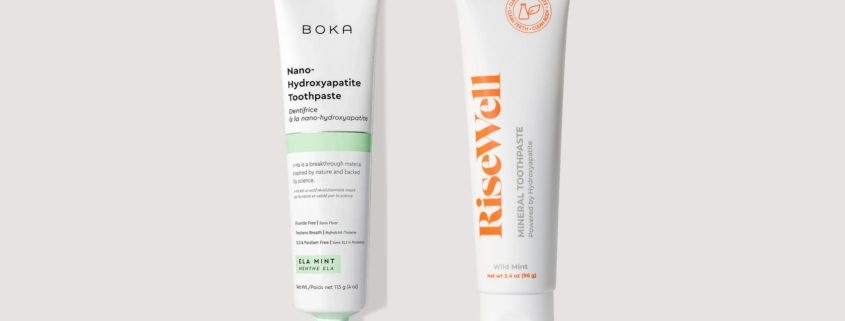
You’ve probably seen the tubes at Whole Foods or in your Instagram feed. Boka. RiseWell. Apagard. Davids. The label says “fluoride-free,” the marketing leans clean and minimal, and the active ingredient — nano-hydroxyapatite, or n-HAp — gets credit for everything from remineralizing enamel to preventing cavities to “naturally rebuilding” your teeth.
We’ve been getting a lot of questions about it. So here is what we can actually defend as practicing dentists, separated from what’s marketing.
What It Is
Hydroxyapatite is the mineral your tooth enamel is already made of. Nano-hydroxyapatite is the same mineral milled into particles 20 to 100 nanometers across. It was first developed by NASA in the 1970s for bone and tooth demineralization in astronauts. Japan has had it as an over-the-counter ingredient since 1980 — Apagard has been on Tokyo drugstore shelves for forty years.
That history is real. The mechanism debate is what’s complicated.
What the Evidence Actually Supports
We want to be careful here, because the marketing for these toothpastes is well ahead of the clinical evidence.
Sensitivity reduction is proven. Multiple randomized trials show n-HAp toothpaste reduces dentinal hypersensitivity, often comparably to traditional desensitizing pastes. The mechanism is straightforward — the nanoparticles physically occlude open dentinal tubules at the gumline and on exposed root surfaces. That’s the one claim we’re comfortable making without hedging.
Beyond sensitivity, the evidence weakens.
“Remineralization” the way fluoride does it — actually rebuilding the subsurface enamel structure — has good in vitro support but limited clinical proof. The lab studies look promising. The real-world cavity-prevention data is thinner and the mechanism is debated.
“Enamel protection” — the deposited n-HAp layer is real but transient. It can be brushed off, abraded, or dissolved by the next acid exposure. Head-to-head against fluoride, fluoride performs equal or better at acid resistance in most studies.
“Cavity prevention” — a handful of randomized trials have shown non-inferiority to fluoride in specific populations (notably the Schlagenhauf orthodontic study and a pediatric study by Paszynska). But critics, including ADA reviewers, have noted that the prevention seen could be explained by tubule occlusion and surface effects without true remineralization. We don’t yet have the decades-long, large-population data fluoride has.
The honest summary: n-HAp toothpastes are promising. They are not yet proven for anything beyond sensitivity.
How We Actually Use It in Practice
Given the above, here is the framework we use chairside.
If you have sensitive teeth — at the gumline, after whitening, with cold drinks — n-HAp is a real option. Often as effective as Sensodyne, sometimes more tolerable. This is the use case where the evidence holds up.
If you simply prefer a fluoride-free routine — for personal reasons, dietary philosophy, whatever — n-HAp is the most defensible fluoride-free choice on the market. We won’t tell you it’s equivalent to fluoride for cavity prevention, because the evidence doesn’t yet support that. But it’s better than the alternatives, and if it gets you to brush twice a day with something active in the tube, that matters.
If you have a history of cavities, active decay, dry mouth, orthodontic appliances, or any elevated caries risk — we recommend fluoride. The clinical evidence for fluoride’s cavity-prevention effect is six decades deep and overwhelming. n-HAp can supplement, but it shouldn’t replace.
For kids — we follow the standard guidance: small smear of fluoride paste from first tooth, pea-sized at age three, supervised brushing. If a child won’t tolerate fluoride or there’s a strong family preference, n-HAp is a reasonable bridge until they can manage fluoride properly.
Brands We See Most Often
We don’t sell paste at the practice and we’re not affiliated with any of these brands. The two we see most often in our patients’ bathrooms are Boka — widely available at Target, Whole Foods, and Amazon, with pleasant flavors and a kids’ line — and RiseWell, founded by a hygienist, well-balanced mint, and strong on the family side.
Two others worth knowing about: Apagard is the Japanese original (Premio is the standard; M-Plus is their advanced formula, forty-year track record). Davids is US-made in an aluminum tube with a newer n-HAp formula.
What to Tell Us
If you’ve switched or you’re considering switching, tell us. We adjust our exam — what we screen for, how often we recommend fluoride varnish at your cleaning, how aggressively we treat early lesions — based on what you’re actually doing at home. No judgment in either direction.
The best toothpaste is the one you actually use, twice a day, every day, for thirty years. The evidence base matters too.
Schedule a visit or call (212) 245-2888. We’re at 200 W. 57th Street, Suite 1405.
Frangella Dental is a family-run cosmetic and general dentistry practice in Midtown Manhattan, focused on practical, evidence-based care.