
It’s one of the most common questions I get, usually from a parent of a teenager: the dentist mentioned wisdom teeth, and now everyone’s wondering whether surgery is coming. The honest answer is that it depends — and “it depends” is actually the evidence-based answer, not a dodge. Plenty of wisdom teeth need to come out. Plenty of others can be left alone and simply watched. The skill is in telling the two apart, and I’d rather walk you through how that decision actually gets made than have you assume every wisdom tooth is automatically a problem.
What wisdom teeth are, and why they cause trouble
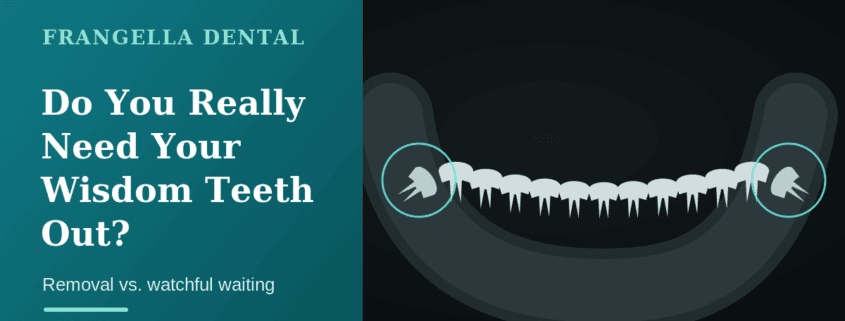
Wisdom teeth are your third molars, the last teeth to come in, usually between about 17 and 25. For a lot of people there simply isn’t room for them at the back of the jaw. When a tooth doesn’t have space to come in fully, we call it impacted — it may be stuck under the gum, tilted against the tooth in front of it, or only partly erupted. That’s where the potential for trouble comes from: not the tooth itself, but the position it’s stuck in and what that position does to the tissue and teeth around it.
Importantly, “impacted” is not the same as “problem.” Many impacted wisdom teeth sit quietly for decades. The question is never just “is it impacted?” — it’s “is it causing harm, or likely to?”
When removal is clearly the right call
There’s little debate about wisdom teeth that are actively causing problems. I recommend removal when I see things like recurrent infection or inflammation around a partly erupted tooth (pericoronitis) — the gum flap over a half-erupted wisdom tooth traps food and bacteria and can flare painfully again and again. Decay in the wisdom tooth or, just as important, in the second molar right in front of it, which a tilted wisdom tooth makes almost impossible to keep clean. Cysts or damage to the neighboring tooth’s root. Gum disease localized to that area that won’t resolve. And in some cases, a tooth that’s clearly on a path to these problems based on its angle and position.
When any of these are present or genuinely imminent, taking the tooth out is the straightforward, evidence-supported choice — and doing it sooner is usually easier, with faster healing, than waiting until there’s an emergency.
The real debate: healthy, symptom-free, impacted teeth
Here’s where it gets more nuanced, and where I want to be straight with you. The genuinely debated question in dentistry is what to do with wisdom teeth that are impacted but causing no symptoms and showing no disease.
On this specific question, the highest-quality evidence is honest about its own limits. Cochrane reviews — which pool the best available studies — have repeatedly concluded there isn’t enough strong evidence to either support or refute routine “just in case” removal of asymptomatic, disease-free impacted wisdom teeth. Research on watchful waiting, where these teeth are monitored rather than removed, has found that relatively few of them go on to develop problems requiring surgery, and that prophylactic removal carries its own costs — surgery, recovery time, and a small but real risk of complications.
At the same time, there’s a legitimate case on the other side. Surgical bodies such as the American Association of Oral and Maxillofacial Surgeons point out that some retained wisdom teeth quietly cause decay on the back of the second molar — a problem that’s often caught late and can threaten a tooth you actually want to keep — and that removal is generally easier and heals better in a younger patient than later in life. Health systems that discourage routine removal, like the UK’s NICE guidance, weigh it the other way, favoring monitoring.
The takeaway isn’t that one camp is right and the other wrong. It’s that for a symptom-free, disease-free impacted wisdom tooth, this is a judgment call that should be made about your specific mouth — your tooth’s angle, how cleanable it is, your age, and what we can see changing over time — not by a blanket rule.
How I approach the decision
My philosophy is simple: I don’t remove teeth that don’t need removing, and I don’t wait on teeth that are clearly heading for trouble. For every wisdom tooth, we look at the actual evidence in front of us — a clinical exam and an X-ray (or a 3D scan when the position or nerve proximity warrants it) — and ask a few concrete questions. Is it causing symptoms now? Can you clean it, and can you clean the tooth in front of it? Is there any sign of decay, infection, cyst, or bone loss? Based on its angle and space, is it realistically going to erupt usefully, sit quietly, or cause problems down the line?
If a tooth is healthy, cleanable, and stable, watchful waiting — keeping an eye on it with periodic exams and images — is a perfectly legitimate plan, and often the right one. If it’s causing problems or clearly will, we talk about removing it, and I’ll explain exactly why. Either way, you’ll understand the reasoning, not just the recommendation.
The bottom line
Not everyone needs their wisdom teeth out, and “everybody gets them removed” was never good medicine. But some people genuinely do, and putting off a clearly problematic extraction can cost you the healthy tooth next door. The right answer comes from looking at your teeth specifically — not from a rule of thumb in either direction.
If you or your teenager has wisdom teeth on the radar, schedule a visit and let’s actually look. I’ll give you a clear, honest read on whether it’s a “leave it and watch” or a “let’s take care of it” — and the reasons behind whichever it is.
This post is general information, not a substitute for an individual exam. Wisdom tooth decisions depend on your specific anatomy and health, so schedule a visit for advice tailored to you.
