Illustration of a tooth connected by a heartbeat line to a heart, with text: Beyond the Tooth - new research links root canal treatment to better blood sugar, cholesterol and lower inflammation.

When most people hear “root canal,” they think of one thing: relief from pain, and keeping a tooth they’d otherwise lose. That’s still the main reason we do them. But a growing body of research suggests treating an infected tooth may quietly benefit the rest of your body too, and a new clinical study out of King’s College London is one of the most interesting pieces of evidence yet.

What the study found

Researchers at King’s College London followed 65 patients over two years after they had root canal treatment for a common infection called apical periodontitis, an infection that forms at the tip of a tooth’s root, usually after decay or trauma reaches the nerve. Using a sensitive blood-analysis technique (NMR spectroscopy), the team tracked what happened to patients’ blood chemistry over time.

After successful treatment, they saw three changes worth noting:

  • Blood sugar control improved. Glucose levels dropped meaningfully over the two years, the kind of shift that matters for diabetes risk.
  • Cholesterol and blood fats improved, at least in the shorter term.
  • Markers of inflammation went down. Inflammation is a thread that runs through heart disease and many other chronic conditions.

The likely explanation is straightforward. A long-standing root infection gives bacteria a doorway into the bloodstream, where they can stir up body-wide inflammation and nudge blood sugar and blood fats in the wrong direction. Clear the infection, and that low-grade burden appears to ease.

Why this fits what we already know

None of this is as surprising as it might sound. Dentistry has understood for years that the mouth isn’t sealed off from the rest of the body, the “oral-systemic” link. Gum disease, for example, is well established as being connected to diabetes and cardiovascular disease. What makes this study notable is that it’s one of the first to actually measure the metabolic benefit of treating a root infection, rather than just documenting the risk of leaving one alone.

The honest caveats

I want to be straight with you about what this study does and doesn’t prove, because that matters more than a good headline. It was a small study, 65 people, and it followed patients over time rather than comparing them against an untreated control group. That means it shows an association, not ironclad proof that the root canal caused every improvement. The cholesterol benefits were described as short-term. Larger, longer studies are needed to confirm how strong and lasting these effects really are. The researchers themselves said as much.

So the takeaway isn’t “get a root canal to lower your cholesterol.” It’s that treating a dental infection promptly is very likely doing more good than we used to be able to measure, and there’s no downside to clearing an infection your body has been quietly fighting.

What this means for you

The practical message is the same one we’ve always given, now with a little more weight behind it: don’t sit on a tooth infection. A cracked or deeply decayed tooth, lingering sensitivity to hot or cold, a pimple-like bump on the gum, or a dull ache that won’t quit are all worth having looked at. Catching these early usually means a simpler procedure and a better outcome, for the tooth, and possibly for the rest of you.

If you’ve been putting off dealing with a problem tooth, or you’re not sure whether that occasional twinge is something to worry about, we’re happy to take a look and give you a straight answer.


This post summarizes research published in the Journal of Translational Medicine (King’s College London, 2025) for general educational purposes. It isn’t medical advice, and it doesn’t replace an exam. If you have a specific concern about a tooth or your health, give us a call and we’ll help you sort it out.
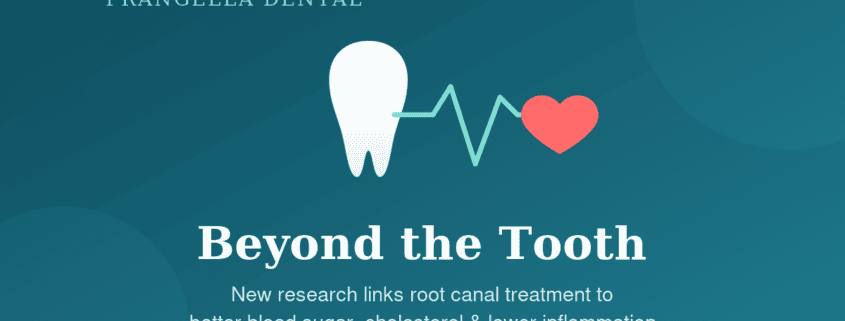
Stylized panoramic dental X-ray of the lower jaw showing both third molars mesioangularly impacted against the second molars, highlighted

It’s one of the most common questions I get, usually from a parent of a teenager: the dentist mentioned wisdom teeth, and now everyone’s wondering whether surgery is coming. The honest answer is that it depends — and “it depends” is actually the evidence-based answer, not a dodge. Plenty of wisdom teeth need to come out. Plenty of others can be left alone and simply watched. The skill is in telling the two apart, and I’d rather walk you through how that decision actually gets made than have you assume every wisdom tooth is automatically a problem.

What wisdom teeth are, and why they cause trouble

Wisdom teeth are your third molars, the last teeth to come in, usually between about 17 and 25. For a lot of people there simply isn’t room for them at the back of the jaw. When a tooth doesn’t have space to come in fully, we call it impacted — it may be stuck under the gum, tilted against the tooth in front of it, or only partly erupted. That’s where the potential for trouble comes from: not the tooth itself, but the position it’s stuck in and what that position does to the tissue and teeth around it.

Importantly, “impacted” is not the same as “problem.” Many impacted wisdom teeth sit quietly for decades. The question is never just “is it impacted?” — it’s “is it causing harm, or likely to?”

When removal is clearly the right call

There’s little debate about wisdom teeth that are actively causing problems. I recommend removal when I see things like recurrent infection or inflammation around a partly erupted tooth (pericoronitis) — the gum flap over a half-erupted wisdom tooth traps food and bacteria and can flare painfully again and again. Decay in the wisdom tooth or, just as important, in the second molar right in front of it, which a tilted wisdom tooth makes almost impossible to keep clean. Cysts or damage to the neighboring tooth’s root. Gum disease localized to that area that won’t resolve. And in some cases, a tooth that’s clearly on a path to these problems based on its angle and position.

When any of these are present or genuinely imminent, taking the tooth out is the straightforward, evidence-supported choice — and doing it sooner is usually easier, with faster healing, than waiting until there’s an emergency.

The real debate: healthy, symptom-free, impacted teeth

Here’s where it gets more nuanced, and where I want to be straight with you. The genuinely debated question in dentistry is what to do with wisdom teeth that are impacted but causing no symptoms and showing no disease.

On this specific question, the highest-quality evidence is honest about its own limits. Cochrane reviews — which pool the best available studies — have repeatedly concluded there isn’t enough strong evidence to either support or refute routine “just in case” removal of asymptomatic, disease-free impacted wisdom teeth. Research on watchful waiting, where these teeth are monitored rather than removed, has found that relatively few of them go on to develop problems requiring surgery, and that prophylactic removal carries its own costs — surgery, recovery time, and a small but real risk of complications.

At the same time, there’s a legitimate case on the other side. Surgical bodies such as the American Association of Oral and Maxillofacial Surgeons point out that some retained wisdom teeth quietly cause decay on the back of the second molar — a problem that’s often caught late and can threaten a tooth you actually want to keep — and that removal is generally easier and heals better in a younger patient than later in life. Health systems that discourage routine removal, like the UK’s NICE guidance, weigh it the other way, favoring monitoring.

The takeaway isn’t that one camp is right and the other wrong. It’s that for a symptom-free, disease-free impacted wisdom tooth, this is a judgment call that should be made about your specific mouth — your tooth’s angle, how cleanable it is, your age, and what we can see changing over time — not by a blanket rule.

How I approach the decision

My philosophy is simple: I don’t remove teeth that don’t need removing, and I don’t wait on teeth that are clearly heading for trouble. For every wisdom tooth, we look at the actual evidence in front of us — a clinical exam and an X-ray (or a 3D scan when the position or nerve proximity warrants it) — and ask a few concrete questions. Is it causing symptoms now? Can you clean it, and can you clean the tooth in front of it? Is there any sign of decay, infection, cyst, or bone loss? Based on its angle and space, is it realistically going to erupt usefully, sit quietly, or cause problems down the line?

If a tooth is healthy, cleanable, and stable, watchful waiting — keeping an eye on it with periodic exams and images — is a perfectly legitimate plan, and often the right one. If it’s causing problems or clearly will, we talk about removing it, and I’ll explain exactly why. Either way, you’ll understand the reasoning, not just the recommendation.

The bottom line

Not everyone needs their wisdom teeth out, and “everybody gets them removed” was never good medicine. But some people genuinely do, and putting off a clearly problematic extraction can cost you the healthy tooth next door. The right answer comes from looking at your teeth specifically — not from a rule of thumb in either direction.

If you or your teenager has wisdom teeth on the radar, schedule a visit and let’s actually look. I’ll give you a clear, honest read on whether it’s a “leave it and watch” or a “let’s take care of it” — and the reasons behind whichever it is.


This post is general information, not a substitute for an individual exam. Wisdom tooth decisions depend on your specific anatomy and health, so schedule a visit for advice tailored to you.

Frangella Dental blog featured graphic: Viral Whitening Hacks - what the evidence actually says, with a tooth illustration

Every few weeks a new whitening “hack” goes viral — charcoal powder, a lemon-and-baking-soda paste, a swig of drugstore hydrogen peroxide. The videos are convincing, the before-and-afters look dramatic, and the price is right: nearly free. As a dentist, I get asked about these constantly, so I want to walk through what the research actually shows, where the real risk is, and what a whiter smile takes without wrecking your enamel in the process.

A quick note up front: I’m not here to scare anyone off wanting whiter teeth. That’s a completely reasonable goal. The problem isn’t the goal — it’s that a few of these methods trade a short-term cosmetic bump for permanent damage to a tissue your body can’t regrow.

Why enamel is the whole ballgame

Enamel is the hard outer shell of your tooth, and it’s the most mineralized tissue in the human body. It’s also, crucially, non-living. Once it’s worn away or eroded, it does not grow back. Underneath it sits dentin, which is naturally more yellow. So here’s the irony at the center of most viral whitening hacks: methods that strip or thin enamel can make teeth look whiter for a day or two from surface polishing, then leave them looking darker over time as more yellow dentin shows through — and more sensitive, because dentin has nerve pathways enamel doesn’t.

That single fact explains most of what follows.

Activated charcoal: the number that actually matters is RDA

Charcoal toothpastes and powders are probably the most-hyped option, and this is where I want to be precise rather than lump everything together. The claim you see online is that charcoal “absorbs” stains. The honest picture: a 2022 systematic review of laboratory studies found that activated charcoal products showed no meaningful bleaching advantage over conventional whitening toothpastes — in other words, charcoal helps lift surface stain, it doesn’t lighten the underlying shade of your teeth. So if a video promises charcoal will take you several shades whiter, that’s overselling it.

The real safety question isn’t “charcoal: yes or no” — it’s abrasivity, measured as Relative Dentin Abrasivity (RDA). This is the number that actually matters, and it’s where products differ enormously. The gritty powders behind most horror stories run high — many measured in the 150–200+ range — and that’s what roughens enamel and, over time, contributes to gum recession. Anything under about 100 is considered gentle for daily use. So the problem was never the word “charcoal” on the label; it was coarse, high-RDA formulations.

Full disclosure, because it’s relevant here: I make a charcoal toothpaste, White Birch activated charcoal, and I formulated it specifically around this issue. It comes in at a low 45 RDA — less than half the ~100 threshold for safe daily use, and a fraction of the 150–200+ you see in the abrasive powders. That means you get the charcoal experience for lifting surface stain without the enamel wear that makes the category risky. I’d still set expectations the same way I would for any patient: think of it as a gentle, low-abrasion way to keep surface stain in check, not a substitute for actual whitening if you want a real shade change.

One more note on the category: as of 2025, no charcoal toothpaste has earned the ADA Seal of Acceptance, so “ADA-accepted” isn’t a box charcoal products can currently check. RDA and sensible formulation are the practical things to look at.

Lemon juice, apple cider vinegar, and other fruit-acid hacks

This is the one I’d most like to see disappear. Applying lemon juice, vinegar, or a lemon-and-baking-soda paste puts a strong acid directly against your enamel. Acid softens and dissolves the mineral surface — that’s simple chemistry, and it’s the same process behind the acid erosion we see clinically in patients with frequent citrus or soda habits. Any “whitening” you notice is largely enamel being etched away, which is exactly backwards from what you want. The predictable downstream results are sensitivity, higher cavity risk, and teeth that actually look duller as dentin shows through.

DIY hydrogen peroxide

Peroxide is worth talking about carefully, because it’s genuinely the active ingredient in professional whitening — so people reasonably assume the drugstore bottle will do the same job. The difference is concentration, formulation, and protection. In the office, we use stabilized peroxide gels at controlled concentrations, kept off your gums with barriers and applied for defined times. Swishing straight 3% (or, worse, higher “food-grade”) peroxide is a different thing: it can cause chemical irritation and burns to the gums, tongue, and soft tissue, and unsupervised repeated use can drive sensitivity. Same molecule, very different margin of safety.

So what actually works?

Whitening does work — it just needs to target stain without stripping enamel. Good daily habits do more than people expect. Brushing, flossing, and limiting the big staining culprits — coffee, tea, red wine, tobacco — prevents a lot of discoloration in the first place. A low-abrasion toothpaste (like a well-formulated charcoal option at a low RDA, or an ADA-Seal whitening toothpaste with mild polishing agents) can keep surface stains in check safely, though neither will change your tooth’s underlying shade.

For a real shade change, professional teeth whitening supervised by a dentist is the reliable route — whether that’s custom take-home trays fitted to your teeth or an in-office treatment. The advantage isn’t just strength; it’s that we screen first. Not all discoloration responds to whitening. Stains from certain medications, trauma, or internal tooth changes won’t budge with peroxide, and no amount of charcoal will touch them either. Sometimes the right answer is bonding or a veneer, and sometimes a tooth that looks “stained” is actually signaling decay or an old restoration that needs attention — which is worth knowing before you spend months polishing at it.

The honest bottom line

If a whitening method is free, abrasive, or acidic, it’s usually working by removing tooth structure rather than lifting stain — and that’s a trade you don’t get to undo. The exception is formulation done right: a low-RDA product is gentle by design. Wanting a brighter smile is fine. The safest way to get there is to start with a quick conversation about what’s actually causing the discoloration, then match the method to the cause.

If you’re not sure whether your teeth are a good candidate for whitening — or you’ve tried something from the internet and your teeth have gotten sensitive — schedule a visit and let’s take a look before it becomes a bigger problem.


This post is general information, not a substitute for an individual exam. If you have specific concerns about your teeth, schedule a visit so we can evaluate them directly.