Close-up natural smile illustrating dental bonding versus porcelain veneers

Patients often come in asking a very direct question: Should I do bonding or veneers?

It sounds like a choice between two cosmetic materials. In reality, it is a choice between two very different ways of treating a tooth.

Composite bonding adds tooth-colored resin directly to the existing tooth. Porcelain veneers use a thin ceramic restoration that is bonded to the front of the tooth after careful planning and, in many cases, some enamel preparation.

Both can look excellent. Both can also be the wrong treatment if they are being used to solve the wrong problem.

Here is how I think through the decision when someone wants to improve chipped, worn, uneven, spaced, or discolored front teeth.

Bonding is usually the more conservative starting point

For a small chip, an uneven edge, a modest gap, or one tooth that is slightly out of proportion, bonding can be a very good treatment.

The biggest advantage is conservation. In many cases we can add material without removing much, if any, healthy enamel. The resin is shaped directly on the tooth, hardened, adjusted to the bite, and polished.

That makes bonding especially useful when the underlying tooth is already healthy and attractive but needs a limited correction.

It is also repairable. If a bonded edge chips years later, we can often repair the affected area rather than replacing an entire restoration.

The tradeoff is that composite resin is not porcelain. Over time it can pick up stain, lose some polish, or chip at thin edges. The more material we add, the more those limitations matter.

Veneers are better when the problem is broader

Veneers become more useful when we are trying to change several things at once: color, shape, proportion, surface texture, spacing, and symmetry across multiple teeth.

Porcelain is more color-stable than composite resin and can hold surface gloss extremely well. It also gives the laboratory and dentist more control when we are redesigning a group of teeth rather than fixing one isolated defect.

But a veneer is not automatically a better version of bonding. It is a more involved restorative treatment, and once healthy tooth structure is removed, that decision is not reversible.

That is why the preparation matters so much. Clinical research has consistently shown that ceramic veneers perform best when they can be bonded primarily to enamel rather than deeply prepared dentin. A recent systematic review found the strongest survival and success outcomes when veneers were bonded to enamel. That is one reason conservative planning is not just cosmetic philosophy; it affects longevity.

A chipped tooth is not the same as a worn-down smile

This distinction gets missed online.

If one front tooth has a small traumatic chip, bonding may be all that is needed.

If several front teeth are shortened because of years of grinding, erosion, or an unstable bite, simply adding composite to the edges without understanding the cause can create repeated fractures.

In those cases, the diagnosis comes first. We need to look at the bite, the pattern of wear, the amount of enamel remaining, the position of the teeth, and whether the back teeth are supporting the bite correctly.

Composite can still be very useful for worn teeth. Recent evidence supports it as a conservative option in appropriate cases, particularly for localized anterior wear, but the long-term result depends heavily on case selection and how the bite is managed.

If the teeth are crooked, neither treatment may be the first move

This is where cosmetic dentistry can become unnecessarily aggressive.

If a tooth is significantly rotated or pushed forward, covering the problem with thick bonding or preparing the tooth heavily for a veneer may create a bulky result or require more enamel removal than we would like.

Sometimes a small amount of orthodontic movement first is the most conservative answer. Moving the tooth into a better position can reduce how much restorative material is needed afterward—or eliminate the need for veneers entirely.

That is also why we use digital scans when planning cosmetic cases. The same iTero technology we use for Invisalign and restorative work helps us evaluate tooth position before deciding how much should be added or removed.

What about staining and tooth color?

If the main concern is color, I usually want to know whether whitening can solve the problem before we start covering teeth.

Whitening changes natural enamel. Bonding and porcelain do not whiten after they are placed.

So if someone is considering bonding or veneers and also wants a brighter shade, the sequence matters. Whitening first may allow us to match the restorative material to the final tooth color instead of doing the restorations first and chasing the shade afterward.

For patients comparing options, our guide to in-office versus at-home whitening explains the differences.

How long do bonding and veneers last?

There is no honest single number because longevity depends on the size of the restoration, the bite, grinding habits, diet, oral hygiene, and how much enamel is available for bonding.

In general, composite bonding should be viewed as maintainable rather than permanent. Small bonded areas may last for many years, but polishing, repair, or replacement is normal over time.

Porcelain veneers can have excellent long-term survival when they are carefully planned, conservatively prepared, and well bonded. Long-term studies of enamel-bonded porcelain veneers have reported high survival over a decade, but that should not be translated into a guarantee for every patient or every tooth.

The useful question is not, “Which one lasts forever?” Neither does.

The better question is, “Which treatment gives this tooth the best balance of appearance, durability, and preservation of healthy structure?”

Bonding is usually better when…

  • The problem is small and localized.
  • You have a minor chip, gap, or uneven edge.
  • The underlying tooth color is acceptable.
  • We can improve the shape without making the tooth bulky.
  • Preserving untouched enamel is the priority.
  • You understand that composite may need periodic polishing or repair.

Veneers are usually better when…

  • Several front teeth need coordinated changes in shape and proportion.
  • Color cannot be predictably corrected with whitening alone.
  • There is enough enamel to plan a conservative preparation.
  • You want a more color-stable and wear-resistant restorative surface.
  • The bite and tooth position make veneers appropriate without aggressive reduction.

And sometimes the right answer is neither

A healthy tooth should not be restored just because we have the ability to restore it.

If whitening solves the problem, whiten. If orthodontics solves the problem, move the tooth. If a tiny chip only needs smoothing, sometimes we simply smooth it.

We recently discussed the opposite end of the spectrum in our article on “Turkey Teeth”, where healthy teeth are sometimes aggressively reduced for full crowns in the name of a fast cosmetic transformation. That is very different from conservative veneer dentistry.

At Frangella Dental, the goal is not to fit every cosmetic concern into the same treatment. It is to use the least invasive option that can predictably accomplish what the patient is asking for.

So: bonding or veneers?

If you have one or two small defects, bonding is often the first option I would want to consider.

If you are changing the color, shape, and proportion of several teeth at the same time, veneers may offer better control and long-term stability.

But the decision should come after we evaluate the teeth—not before. A good cosmetic plan accounts for enamel, bite, tooth position, gum levels, existing restorations, and your expectations before any tooth is altered.

If you want to see the range of problems that can be treated conservatively, our patient gallery includes examples of restorative and cosmetic work completed at Frangella Dental.


Dr. Andrew Frangella provides cosmetic and general dentistry at Frangella Dental in Midtown Manhattan. If you are deciding between bonding, veneers, whitening, or orthodontic treatment, call (212) 245-2888 to schedule a consultation at 200 W. 57th Street, Suite 1405.

Smiling woman with warm holiday lights representing cosmetic dental treatment before the holidays

Every fall, we start getting some version of the same question: Is there still enough time to fix my smile before the holidays?

Usually, yes — but the answer depends entirely on what you want to change.

Some improvements can happen in a single visit. Others need a few weeks. And some treatments simply should not be rushed because there is a holiday party on the calendar.

Here’s how I think about the timeline when a patient sits down and tells me, “I want my smile to look better by Thanksgiving, Christmas, or New Year’s.”

First: what actually bothers you?

“I don’t like my smile” can mean ten different things.

For one person, the teeth are healthy and straight but darker than they used to be. Another has one chipped front tooth that catches their eye in every photograph. Someone else may have crowding, worn edges, old bonding, uneven gum levels, or several things happening at once.

That distinction matters because the fastest treatment is not automatically the right treatment.

Before doing cosmetic dentistry, we first make sure the teeth and gums are healthy and figure out exactly what is creating the appearance you want to change. Sometimes the answer is much simpler than the patient expected.

If your teeth just need to look cleaner and brighter

Timeline: days to a few weeks.

If it has been a while since your cleaning, start there. Stain and buildup can change the appearance of teeth more than people realize, particularly around the gumline and between teeth.

If the teeth are healthy and the issue is color, whitening is one of the quickest ways to make a noticeable change without altering the tooth structure.

The important part is setting expectations. Whitening changes the color of natural enamel. It does not change the color of crowns, veneers, or existing tooth-colored fillings. If you have restorations on your front teeth, we need to account for that before whitening so you don’t end up with mismatched shades.

If you have a chip, uneven edge, or small gap

Timeline: often one or two visits.

Composite bonding can be extremely useful for small, specific problems. Tooth-colored resin is shaped directly on the tooth to repair a chip, close a modest space, or improve an uneven edge.

It is conservative because, depending on the situation, little or no healthy enamel needs to be removed.

But bonding has limits. Trying to solve a large alignment, bite, or color problem with excessive composite can create bulky teeth and a result that is harder to maintain. I would rather tell someone that bonding is not the right tool than make every cosmetic problem fit the fastest treatment.

If you are considering veneers

Timeline: generally several weeks, after proper planning.

Veneers can change color, shape, proportion, spacing, and symmetry at the same time, which is why they can create a dramatic result relatively quickly.

That does not mean they should be treated as an emergency makeover.

The planning matters. We need to evaluate your bite, the amount and position of enamel, your gum levels, the shape you are trying to achieve, and whether veneers are even necessary on every tooth you are considering.

There is also an important difference between conservative porcelain veneers and aggressively preparing healthy teeth for full crowns. We recently wrote about that distinction in our discussion of “Turkey Teeth”. Once healthy tooth structure is removed, it does not grow back.

If veneers are appropriate, I want enough time to plan them properly rather than designing treatment backward from a party date.

If the real problem is tooth position

Timeline: months, not weeks.

This is where holiday deadlines can push people toward the wrong decision.

If teeth are crowded, rotated, or positioned in a way that is driving the cosmetic problem, orthodontic treatment such as Invisalign may be the most conservative solution because we are moving your own teeth rather than covering the problem with restorative material.

Some patients notice improvement fairly early, but meaningful orthodontic movement takes time. Starting Invisalign now may absolutely improve your smile over the coming months, but I would not promise a finished orthodontic result by a nearby holiday simply because that is the date we would like.

We use our iTero digital scanner to evaluate tooth position and plan Invisalign without conventional impressions.

Sometimes the best plan uses more than one treatment

Cosmetic dentistry is often better when we do less of each thing.

A little orthodontic movement can put a tooth in a position that requires less bonding or less porcelain. Whitening first can mean fewer restorations need to be replaced for color. Correcting inflamed gums before cosmetic work can completely change where the final tooth should end.

That is why I am cautious when someone arrives with a treatment already selected from Instagram or TikTok. Start with the outcome you want, not the procedure you think you need.

So what can realistically be done before the holidays?

If you came in this fall, this is the rough way I would think about it:

  • Cleaning and stain removal: very realistic.
  • Professional whitening: usually realistic.
  • Small chips, gaps, or edge corrections with bonding: often realistic.
  • Replacing a limited number of unattractive old restorations: often realistic, depending on the case.
  • Porcelain veneers: potentially realistic, but only if there is adequate time for diagnosis, planning, preparation, and laboratory work.
  • Invisalign: realistic to start; whether it can be completed depends on how much movement is required.

And occasionally the right answer is: don’t do anything yet.

If I think rushing treatment compromises the result or removes healthy tooth structure unnecessarily, I would rather have you look the same in this year’s holiday photos and have the right smile next year.

The earlier we look, the more options you have

You do not need to walk into a cosmetic consultation knowing whether you need whitening, bonding, veneers, or Invisalign. That is our job to help you figure out.

Bring in what bothers you. We can look at your teeth, your bite, your existing dental work, and your timeline, then tell you what is realistic — including when the simplest option is the best one.


Thinking about improving your smile before the holidays? Dr. Andrew Frangella provides cosmetic and general dentistry at Frangella Dental in Midtown Manhattan. Call (212) 245-2888 to schedule a consultation at 200 W. 57th Street, Suite 1405.
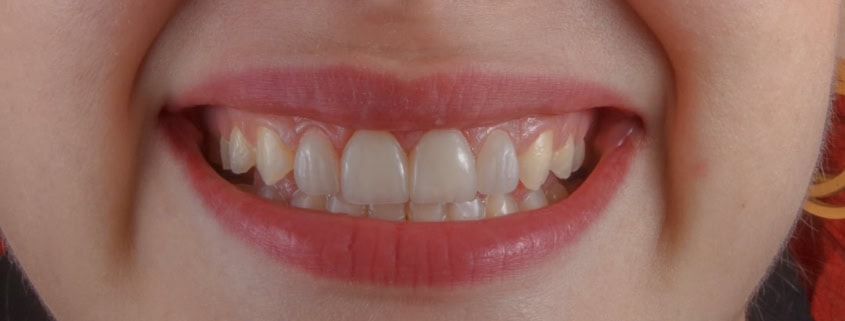
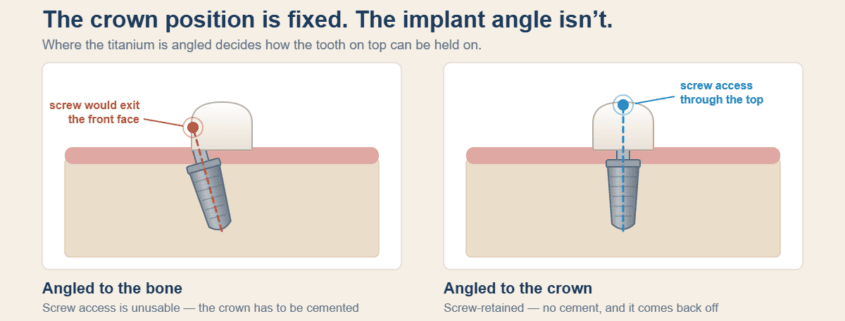
Diagram comparing two implants under identical crowns: one angled to the bone, whose screw channel exits the front face of the crown, and one angled to the crown, whose screw access exits through the biting surface.

Two implants can both be textbook successes by the usual definition — fused to the bone, no pain, no infection, stable for years — and only one of them can be restored well.

That gap is the part of implant dentistry patients almost never hear about, because the number everyone quotes is the survival rate. Implant survival is genuinely high. But survival only measures whether the titanium stayed put. It says nothing about whether the tooth on top of it looks right, cleans easily, or can be repaired in fifteen years without cutting it off.

Position is what decides that. And position has to be planned backward from the crown.

What “successful” usually means

When an implant is placed, the biological goal is osseointegration — bone growing into direct contact with the titanium surface. That process takes roughly three to six months, and when it works, the implant is locked in.

Osseointegration is a low bar for a restoration, though. An implant placed two millimeters too far toward the cheek will integrate beautifully. An implant tipped at the wrong angle will integrate beautifully. Bone doesn’t know or care where the crown was supposed to go.

So an implant can be a surgical success and a restorative headache at the same time. That’s not a rare edge case — it’s the most common way implant treatment quietly underperforms.

Three dimensions, all decided at surgery

Once the implant is in the bone, its position is essentially permanent. Everything the final crown can and can’t be was determined in that appointment.

Side to side. An implant needs roughly 1.5 mm of space between it and a neighboring natural tooth, and about 3 mm between two adjacent implants. Crowd that space and the bone between them resorbs — and the bone is what holds up the gum triangle between your teeth. Lose the bone, lose the papilla, and you get a dark triangle that no amount of ceramic work will fill. This is a bone-height problem masquerading as a cosmetic one.

Depth. The implant sits below the gumline, and how far below shapes the emergence profile — the way the crown widens out of the tissue the way a real tooth does. Too shallow and you see metal or get an abrupt, flat-looking crown. Too deep and the crown margin ends up somewhere no one can clean or access.

Angle. This one has the largest downstream consequence, and it’s the least intuitive. A crown can be held on in one of two ways: a screw through the biting surface, or cement. If the implant is angled so that the screw channel would exit through the front of the tooth, a screw-retained crown is off the table, and the restoration gets cemented instead.

Why the angle matters more than it sounds

Cement is the problem. When a crown is cemented onto an implant below the gumline, excess cement can get pushed into the tissue where it can’t be seen and doesn’t come out on its own.

In a 2009 endoscopic study, excess cement was found in association with signs of peri-implant disease in about 81% of the cases examined — and once the cement was removed, the signs of disease resolved in roughly 74% of those implants. A cross-sectional study published in 2025 found the same relationship. Cement left behind under the gum is one of the more preventable causes of implant inflammation and bone loss.

A screw-retained crown avoids this entirely. It also comes off. If the porcelain chips in year twelve, a screw-retained crown is unthreaded, repaired, and put back. A cemented one usually has to be destroyed to be removed.

None of that is a choice made at the crown appointment. It’s a choice made by where the implant was angled months earlier.

The path of least resistance points the wrong way

Here’s the tension: the position that’s best for the crown is often not the position that’s easiest for the surgery.

Bone isn’t evenly distributed. After a tooth is lost, the ridge tends to resorb from the outside in, so the widest, safest bone frequently sits toward the tongue or palate — or the ideal restorative angle would run the implant right through the thin outer plate of bone. Planning from the crown backward means you sometimes have to graft, use a narrower implant, or accept a more technically demanding placement in order to end up where the tooth needs to be.

Planning from the bone forward is faster and has fewer surgical complications. It also produces implants that are harder to restore.

Neither approach is dishonest. They’re just optimizing for different endpoints — and which endpoint gets optimized depends a lot on who is holding the handpiece and whether that person is the one who has to deliver the crown.

Where doing both phases actually changes something

I place and restore implants in this office, which means I’m the one who has to live with my own surgical decisions six months later.

I want to be careful about what I’m claiming here. I’m not aware of good head-to-head evidence that one-clinician implant care produces better long-term outcomes than a well-coordinated surgeon-and-restorative-dentist team. Plenty of two-office teams do excellent work, and a specialist surgeon doing high volume brings real advantages. So this isn’t a claim about outcome data — it’s a claim about incentives and information.

What changes is that there’s no handoff. I’ve already planned the crown before I plan the surgery — the 3D scan and the digital impression get merged, and the implant position is designed from the finished tooth backward, not the other way around. If that requires grafting, I know that in advance because I’m the one who’s going to be stuck without it. And if something about the position ends up compromising the restoration, there’s no ambiguity about whose problem it is.

Consolidation isn’t automatically better. But it does remove the seam where restorative information tends to get lost.

What to ask, wherever you have it done

If you’re considering an implant — here or anywhere — these are fair questions:

  • Will the position be planned from a 3D scan and a digital impression of the final tooth, or from the bone alone?
  • Will the crown be screw-retained or cemented? If cemented, why?
  • Do I need grafting to put the implant where the crown should go?
  • Who restores it, and how do the two of you communicate about position?

A good answer to these is a better predictor of how the implant will look and last than any survival statistic.


Have questions about implants? Dr. Andrew Frangella places and restores dental implants at Frangella Dental in Midtown Manhattan. Call (212) 245-2888 or schedule a consultation at 200 W. 57th Street, Suite 1405 — steps from Columbus Circle.

References

  • Wilson TG Jr. “The positive relationship between excess cement and peri-implant disease: a prospective clinical endoscopic study.” Journal of Periodontology, 2009. PubMed
  • Montevecchi M, et al. “Excess cement and peri-implant disease: a cross-sectional clinical endoscopic study.” Journal of Periodontology, 2025. PubMed