
Two implants can both be textbook successes by the usual definition — fused to the bone, no pain, no infection, stable for years — and only one of them can be restored well.
That gap is the part of implant dentistry patients almost never hear about, because the number everyone quotes is the survival rate. Implant survival is genuinely high. But survival only measures whether the titanium stayed put. It says nothing about whether the tooth on top of it looks right, cleans easily, or can be repaired in fifteen years without cutting it off.
Position is what decides that. And position has to be planned backward from the crown.
What “successful” usually means
When an implant is placed, the biological goal is osseointegration — bone growing into direct contact with the titanium surface. That process takes roughly three to six months, and when it works, the implant is locked in.
Osseointegration is a low bar for a restoration, though. An implant placed two millimeters too far toward the cheek will integrate beautifully. An implant tipped at the wrong angle will integrate beautifully. Bone doesn’t know or care where the crown was supposed to go.
So an implant can be a surgical success and a restorative headache at the same time. That’s not a rare edge case — it’s the most common way implant treatment quietly underperforms.
Three dimensions, all decided at surgery
Once the implant is in the bone, its position is essentially permanent. Everything the final crown can and can’t be was determined in that appointment.
Side to side. An implant needs roughly 1.5 mm of space between it and a neighboring natural tooth, and about 3 mm between two adjacent implants. Crowd that space and the bone between them resorbs — and the bone is what holds up the gum triangle between your teeth. Lose the bone, lose the papilla, and you get a dark triangle that no amount of ceramic work will fill. This is a bone-height problem masquerading as a cosmetic one.
Depth. The implant sits below the gumline, and how far below shapes the emergence profile — the way the crown widens out of the tissue the way a real tooth does. Too shallow and you see metal or get an abrupt, flat-looking crown. Too deep and the crown margin ends up somewhere no one can clean or access.
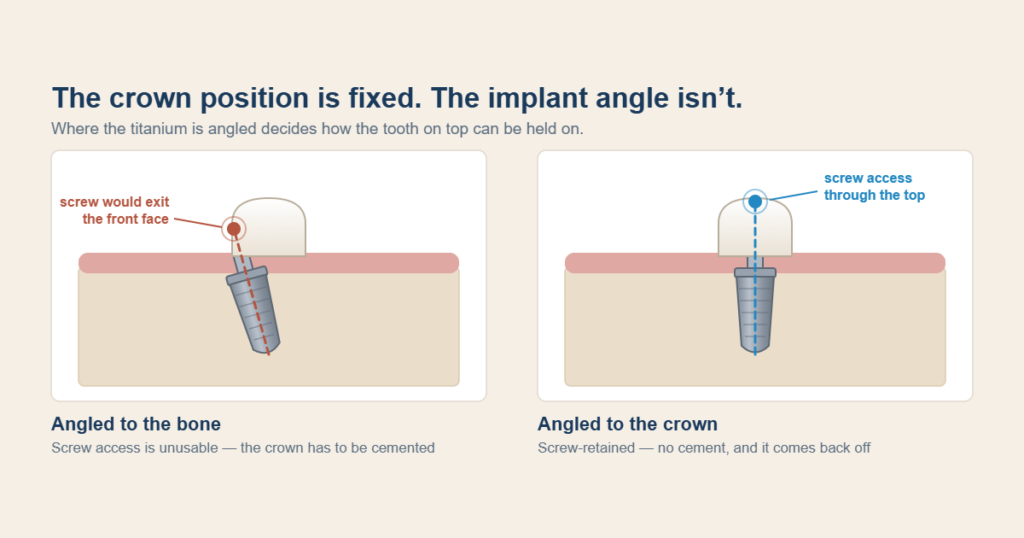
Angle. This one has the largest downstream consequence, and it’s the least intuitive. A crown can be held on in one of two ways: a screw through the biting surface, or cement. If the implant is angled so that the screw channel would exit through the front of the tooth, a screw-retained crown is off the table, and the restoration gets cemented instead.
Why the angle matters more than it sounds
Cement is the problem. When a crown is cemented onto an implant below the gumline, excess cement can get pushed into the tissue where it can’t be seen and doesn’t come out on its own.
In a 2009 endoscopic study, excess cement was found in association with signs of peri-implant disease in about 81% of the cases examined — and once the cement was removed, the signs of disease resolved in roughly 74% of those implants. A cross-sectional study published in 2025 found the same relationship. Cement left behind under the gum is one of the more preventable causes of implant inflammation and bone loss.
A screw-retained crown avoids this entirely. It also comes off. If the porcelain chips in year twelve, a screw-retained crown is unthreaded, repaired, and put back. A cemented one usually has to be destroyed to be removed.
None of that is a choice made at the crown appointment. It’s a choice made by where the implant was angled months earlier.
The path of least resistance points the wrong way
Here’s the tension: the position that’s best for the crown is often not the position that’s easiest for the surgery.
Bone isn’t evenly distributed. After a tooth is lost, the ridge tends to resorb from the outside in, so the widest, safest bone frequently sits toward the tongue or palate — or the ideal restorative angle would run the implant right through the thin outer plate of bone. Planning from the crown backward means you sometimes have to graft, use a narrower implant, or accept a more technically demanding placement in order to end up where the tooth needs to be.
Planning from the bone forward is faster and has fewer surgical complications. It also produces implants that are harder to restore.
Neither approach is dishonest. They’re just optimizing for different endpoints — and which endpoint gets optimized depends a lot on who is holding the handpiece and whether that person is the one who has to deliver the crown.
Where doing both phases actually changes something
I place and restore implants in this office, which means I’m the one who has to live with my own surgical decisions six months later.
I want to be careful about what I’m claiming here. I’m not aware of good head-to-head evidence that one-clinician implant care produces better long-term outcomes than a well-coordinated surgeon-and-restorative-dentist team. Plenty of two-office teams do excellent work, and a specialist surgeon doing high volume brings real advantages. So this isn’t a claim about outcome data — it’s a claim about incentives and information.
What changes is that there’s no handoff. I’ve already planned the crown before I plan the surgery — the 3D scan and the digital impression get merged, and the implant position is designed from the finished tooth backward, not the other way around. If that requires grafting, I know that in advance because I’m the one who’s going to be stuck without it. And if something about the position ends up compromising the restoration, there’s no ambiguity about whose problem it is.
Consolidation isn’t automatically better. But it does remove the seam where restorative information tends to get lost.
What to ask, wherever you have it done
If you’re considering an implant — here or anywhere — these are fair questions:
- Will the position be planned from a 3D scan and a digital impression of the final tooth, or from the bone alone?
- Will the crown be screw-retained or cemented? If cemented, why?
- Do I need grafting to put the implant where the crown should go?
- Who restores it, and how do the two of you communicate about position?
A good answer to these is a better predictor of how the implant will look and last than any survival statistic.
Have questions about implants? Dr. Andrew Frangella places and restores dental implants at Frangella Dental in Midtown Manhattan. Call (212) 245-2888 or schedule a consultation at 200 W. 57th Street, Suite 1405 — steps from Columbus Circle.
References
- Wilson TG Jr. “The positive relationship between excess cement and peri-implant disease: a prospective clinical endoscopic study.” Journal of Periodontology, 2009. PubMed
- Montevecchi M, et al. “Excess cement and peri-implant disease: a cross-sectional clinical endoscopic study.” Journal of Periodontology, 2025. PubMed
