
“Do I really need a crown, or can you save more of my tooth?” It is a question I wish more patients asked.
A tooth with a large filling, a crack, or damage from decay may need something stronger than another routine filling. But that does not automatically mean every remaining surface should be covered with a full crown. Sometimes an onlay—or another partial-coverage restoration—can protect the tooth while preserving more healthy structure.
The decision is not simply crown versus onlay. It is about how much sound tooth remains, where the tooth is weakened, how your bite loads it, and what gives that particular tooth the most predictable future.
Crown vs. Onlay: What’s the Difference?
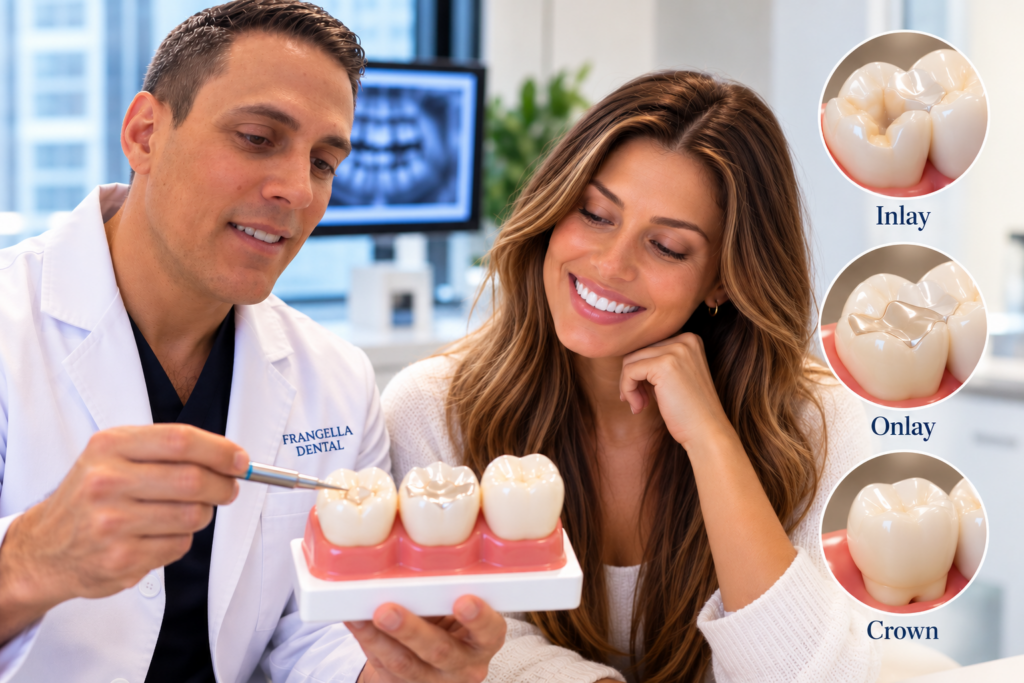
A dental crown covers the prepared tooth circumferentially and generally restores the full chewing surface. It can be appropriate when a tooth has extensive damage, multiple weakened walls, a substantial fracture, or limited remaining structure.
An onlay is an indirect restoration that replaces part of the chewing surface and covers one or more cusps—the raised portions of a back tooth. It can provide cuspal protection without necessarily reducing all the surfaces of the tooth as a full crown would.
An inlay stays within the cusps. A direct filling is placed and shaped in the mouth, whereas crowns, onlays, and inlays are commonly fabricated outside the mouth from a digital scan or impression, then bonded or cemented in place.
These are descriptions of restoration designs, not rankings of quality. A well-selected crown can be the conservative decision when an onlay would leave too little reliable tooth structure.
Why Preserving Natural Tooth Structure Matters
Enamel and dentin are not renewable building materials. Once removed, they do not grow back. That is why I want to avoid unnecessary reduction of healthy tooth structure whenever a less extensive restoration can predictably solve the problem.
But “minimal drilling” is not a treatment plan by itself. A tooth that is already undermined by a large filling may have thin cusps that flex or fracture under chewing forces. Preserving those fragile walls just to say we saved more tooth can be a mistake.
The goal is to preserve useful, healthy, supportable tooth structure while protecting what remains.
When Might an Onlay Be a Good Choice?
An onlay is worth considering when a back tooth has a large or failing filling, one or more weakened cusps, or a defect that needs indirect coverage—but still has enough strong tooth structure for a reliable partial restoration.
For example, imagine a molar with a broad old filling and a weakened chewing cusp, but with otherwise sound outer walls. Depending on the bite, crack pattern, moisture control, and remaining enamel, a bonded ceramic onlay may restore the damaged area without the circumferential preparation required for a crown.
Another patient may have an almost identical-looking filling but a crack extending toward the gumline or significant damage to multiple walls. That tooth may be a much better crown candidate. A photograph of the chewing surface alone rarely tells the whole story.
When Is a Full Crown the Better Option?
A crown may be preferable when there is extensive loss of tooth structure, several compromised cusps, an old restoration with little healthy tooth left, or a fracture pattern that makes partial coverage less predictable.
Sometimes the issue is not just the amount of damage but its location. If a crack, cavity, or previous restoration extends deeply toward the gumline, there may not be enough accessible, healthy structure to support a durable onlay.
Existing crowns also change the equation. Replacing a failing crown with another crown may be more appropriate than trying to redesign a tooth that has already been extensively prepared.
What I do not like is the blanket rule that every large filling automatically needs a crown. We should be able to explain why the selected restoration is necessary for that tooth.
What If the Tooth Is Cracked?
Cracks are one of the reasons this decision becomes complicated. A cracked cusp above the gumline is different from a crack extending down the root. Some cracked teeth can be protected with cuspal coverage; others have a much more guarded prognosis, and a restoration cannot reliably repair every crack.
Symptoms matter. Pain when biting or releasing pressure, temperature sensitivity, swelling, or a history of a sudden fracture can change the evaluation. We examine the tooth, bite, existing restorations, gum findings, and imaging as indicated.
Neither an onlay nor a crown guarantees that a crack will stop progressing. A full crown is not a magic shield, and an onlay is not automatically too weak. The prognosis depends on the actual crack and remaining tooth.
If you have swelling, persistent severe pain, or a broken tooth, schedule a dental examination rather than trying to choose a restoration from an online comparison.
Does a Root Canal Mean You Always Need a Crown?
No—not automatically. But many root-canal-treated back teeth have lost substantial tooth structure from decay, previous fillings, and access preparation. That can make cuspal protection especially important.
The decision depends on the tooth’s position, remaining walls, existing restorations, bite, and how much sound structure is available. A small, conservatively accessed tooth with good remaining support is not the same as a heavily restored molar with two missing cusps.
The goal of root canal treatment is to retain a tooth that can be restored and maintained. The final restoration is part of that success, not an afterthought.
Are Ceramic Onlays as Strong as Crowns?
That question needs context. Modern dental ceramics can perform well in appropriately selected partial- and full-coverage restorations, but material strength alone does not determine clinical success.
Preparation design, remaining enamel and dentin, bonding conditions, restoration thickness, tooth location, chewing forces, grinding habits, and the fit of the restoration all matter.
A ceramic onlay bonded to a well-selected tooth may be an excellent long-term option. A crown on a tooth with inadequate remaining support can still fail. Neither treatment has a guaranteed lifespan, and I would not promise that one always lasts longer than the other.
How Do We Decide at Frangella Dental?
I start with an examination and a discussion about what happened to the tooth. Is an old filling breaking down? Is there a new cavity? Is a cusp cracked? Are we trying to replace a restoration that is failing, or has someone suggested a crown simply because the filling looks large?
Then I evaluate how much tooth is sound, the location of the margins, whether a crack is present, the bite, and whether we can isolate the tooth appropriately for bonding if that is part of the plan.
Digital scans can help us communicate the shape of the tooth and design a restoration. We have discussed how we use iTero digital scanning for crowns and laboratory work. The scanner improves the records we work with; it does not replace the clinical examination.
In some cases, the best answer is still a direct filling. In others, an onlay offers the coverage we need without preparing the entire tooth. And when a crown is indicated, I want to explain what makes it the more predictable choice.
What Does the Procedure Involve?
For an indirect onlay or crown, we generally remove decay or defective restorative material, assess the remaining tooth, prepare the surfaces needed for the chosen design, and capture a scan or impression.
Depending on the treatment and laboratory workflow, a temporary restoration may be needed before the definitive ceramic is placed. At delivery, we evaluate fit, contacts, margins, and bite, then bond or cement the restoration using an appropriate technique.
There may be some short-term sensitivity or tenderness afterward. Persistent pain, a high bite, or symptoms that worsen rather than settle deserve a call to the office.
Is an Onlay Less Expensive Than a Crown in NYC?
Not necessarily. Onlays and crowns are both custom indirect restorations, and their fees depend on the tooth, material, laboratory process, complexity, and whether other treatment is needed.
An onlay should not be chosen because it sounds like a cheaper half-crown, and a crown should not be chosen simply because it is familiar. The most useful comparison is a specific treatment plan with the reason for each option, the expected benefits and limitations, and the actual fee.
Dental insurance coverage also varies. A plan may classify partial-coverage restorations differently from crowns or may have particular documentation requirements. Coverage rules are not a substitute for clinical judgment.
Questions Worth Asking Before You Agree to a Crown
- What specifically is weakened or damaged about this tooth?
- Could an onlay or another partial restoration protect it predictably?
- Is there a crack, and how does that affect the prognosis?
- How much sound tooth would remain after preparation?
- Does grinding or my bite affect the restoration choice?
- What are the tradeoffs, likely maintenance needs, and fees for the reasonable options?
A good treatment recommendation should make sense after the explanation. You should understand what problem we are solving, not just the name of the procedure.
Frequently Asked Questions
Can an onlay fix a broken molar?
Sometimes. If the fracture is limited and there is sufficient healthy structure for a reliable restoration, an onlay may be appropriate. A deeper crack or more extensive damage may require a crown or another treatment.
Is an onlay the same as a three-quarter crown?
They are related partial-coverage concepts, but the terminology and preparation designs are not always identical. Your dentist should explain which surfaces will be covered and why.
Can I replace an old large filling with an onlay?
Possibly. The size of the old filling alone does not decide it. We need to evaluate the remaining cusps, any cracks, recurrent decay, and the bite.
Does a crown prevent a tooth from ever breaking?
No. Crowns can protect compromised tooth structure, but crowned teeth can still develop decay, fractures, gum problems, or other complications. Maintenance and appropriate treatment selection remain important.
The Bottom Line
When a tooth needs more than a filling, the choice is not automatically a full crown. An onlay may provide the necessary protection while preserving more healthy structure in the right case. In another case, a crown may be the safer and more predictable restoration.
My preference is not for one procedure over the other. It is for the most conservative treatment that gives the tooth a reasonable long-term prognosis.
Dr. Andrew Frangella provides restorative, cosmetic, and general dentistry at Frangella Dental in Midtown Manhattan. If you have been told you need a crown and want to understand your options, schedule an examination so we can evaluate the tooth rather than guess from a description.
