
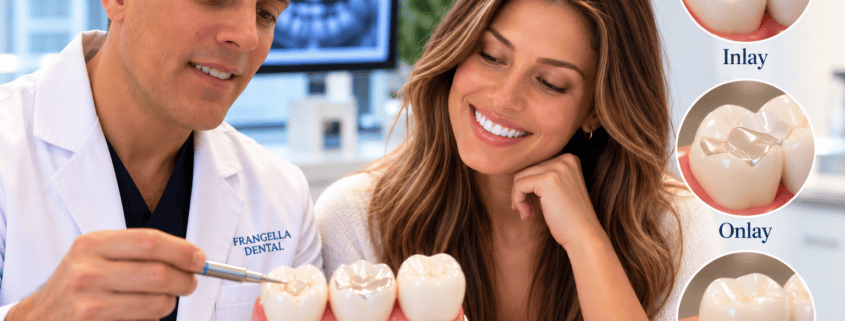
“Do I really need a crown, or can you save more of my tooth?” It is a question I wish more patients asked.

A tooth with a large filling, a crack, or damage from decay may need something stronger than another routine filling. But that does not automatically mean every remaining surface should be covered with a full crown. Sometimes an onlay—or another partial-coverage restoration—can protect the tooth while preserving more healthy structure.

The decision is not simply crown versus onlay. It is about how much sound tooth remains, where the tooth is weakened, how your bite loads it, and what gives that particular tooth the most predictable future.

Crown vs. Onlay: What’s the Difference?

A dental crown covers the prepared tooth circumferentially and generally restores the full chewing surface. It can be appropriate when a tooth has extensive damage, multiple weakened walls, a substantial fracture, or limited remaining structure.

An onlay is an indirect restoration that replaces part of the chewing surface and covers one or more cusps—the raised portions of a back tooth. It can provide cuspal protection without necessarily reducing all the surfaces of the tooth as a full crown would.

An inlay stays within the cusps. A direct filling is placed and shaped in the mouth, whereas crowns, onlays, and inlays are commonly fabricated outside the mouth from a digital scan or impression, then bonded or cemented in place.

These are descriptions of restoration designs, not rankings of quality. A well-selected crown can be the conservative decision when an onlay would leave too little reliable tooth structure.

Why Preserving Natural Tooth Structure Matters

Enamel and dentin are not renewable building materials. Once removed, they do not grow back. That is why I want to avoid unnecessary reduction of healthy tooth structure whenever a less extensive restoration can predictably solve the problem.

But “minimal drilling” is not a treatment plan by itself. A tooth that is already undermined by a large filling may have thin cusps that flex or fracture under chewing forces. Preserving those fragile walls just to say we saved more tooth can be a mistake.

The goal is to preserve useful, healthy, supportable tooth structure while protecting what remains.

When Might an Onlay Be a Good Choice?

An onlay is worth considering when a back tooth has a large or failing filling, one or more weakened cusps, or a defect that needs indirect coverage—but still has enough strong tooth structure for a reliable partial restoration.

For example, imagine a molar with a broad old filling and a weakened chewing cusp, but with otherwise sound outer walls. Depending on the bite, crack pattern, moisture control, and remaining enamel, a bonded ceramic onlay may restore the damaged area without the circumferential preparation required for a crown.

Another patient may have an almost identical-looking filling but a crack extending toward the gumline or significant damage to multiple walls. That tooth may be a much better crown candidate. A photograph of the chewing surface alone rarely tells the whole story.

When Is a Full Crown the Better Option?

A crown may be preferable when there is extensive loss of tooth structure, several compromised cusps, an old restoration with little healthy tooth left, or a fracture pattern that makes partial coverage less predictable.

Sometimes the issue is not just the amount of damage but its location. If a crack, cavity, or previous restoration extends deeply toward the gumline, there may not be enough accessible, healthy structure to support a durable onlay.

Existing crowns also change the equation. Replacing a failing crown with another crown may be more appropriate than trying to redesign a tooth that has already been extensively prepared.

What I do not like is the blanket rule that every large filling automatically needs a crown. We should be able to explain why the selected restoration is necessary for that tooth.

What If the Tooth Is Cracked?

Cracks are one of the reasons this decision becomes complicated. A cracked cusp above the gumline is different from a crack extending down the root. Some cracked teeth can be protected with cuspal coverage; others have a much more guarded prognosis, and a restoration cannot reliably repair every crack.

Symptoms matter. Pain when biting or releasing pressure, temperature sensitivity, swelling, or a history of a sudden fracture can change the evaluation. We examine the tooth, bite, existing restorations, gum findings, and imaging as indicated.

Neither an onlay nor a crown guarantees that a crack will stop progressing. A full crown is not a magic shield, and an onlay is not automatically too weak. The prognosis depends on the actual crack and remaining tooth.

If you have swelling, persistent severe pain, or a broken tooth, schedule a dental examination rather than trying to choose a restoration from an online comparison.

Does a Root Canal Mean You Always Need a Crown?

No—not automatically. But many root-canal-treated back teeth have lost substantial tooth structure from decay, previous fillings, and access preparation. That can make cuspal protection especially important.

The decision depends on the tooth’s position, remaining walls, existing restorations, bite, and how much sound structure is available. A small, conservatively accessed tooth with good remaining support is not the same as a heavily restored molar with two missing cusps.

The goal of root canal treatment is to retain a tooth that can be restored and maintained. The final restoration is part of that success, not an afterthought.

Are Ceramic Onlays as Strong as Crowns?

That question needs context. Modern dental ceramics can perform well in appropriately selected partial- and full-coverage restorations, but material strength alone does not determine clinical success.

Preparation design, remaining enamel and dentin, bonding conditions, restoration thickness, tooth location, chewing forces, grinding habits, and the fit of the restoration all matter.

A ceramic onlay bonded to a well-selected tooth may be an excellent long-term option. A crown on a tooth with inadequate remaining support can still fail. Neither treatment has a guaranteed lifespan, and I would not promise that one always lasts longer than the other.

How Do We Decide at Frangella Dental?

I start with an examination and a discussion about what happened to the tooth. Is an old filling breaking down? Is there a new cavity? Is a cusp cracked? Are we trying to replace a restoration that is failing, or has someone suggested a crown simply because the filling looks large?

Then I evaluate how much tooth is sound, the location of the margins, whether a crack is present, the bite, and whether we can isolate the tooth appropriately for bonding if that is part of the plan.

Digital scans can help us communicate the shape of the tooth and design a restoration. We have discussed how we use iTero digital scanning for crowns and laboratory work. The scanner improves the records we work with; it does not replace the clinical examination.

In some cases, the best answer is still a direct filling. In others, an onlay offers the coverage we need without preparing the entire tooth. And when a crown is indicated, I want to explain what makes it the more predictable choice.

What Does the Procedure Involve?

For an indirect onlay or crown, we generally remove decay or defective restorative material, assess the remaining tooth, prepare the surfaces needed for the chosen design, and capture a scan or impression.

Depending on the treatment and laboratory workflow, a temporary restoration may be needed before the definitive ceramic is placed. At delivery, we evaluate fit, contacts, margins, and bite, then bond or cement the restoration using an appropriate technique.

There may be some short-term sensitivity or tenderness afterward. Persistent pain, a high bite, or symptoms that worsen rather than settle deserve a call to the office.

Is an Onlay Less Expensive Than a Crown in NYC?

Not necessarily. Onlays and crowns are both custom indirect restorations, and their fees depend on the tooth, material, laboratory process, complexity, and whether other treatment is needed.

An onlay should not be chosen because it sounds like a cheaper half-crown, and a crown should not be chosen simply because it is familiar. The most useful comparison is a specific treatment plan with the reason for each option, the expected benefits and limitations, and the actual fee.

Dental insurance coverage also varies. A plan may classify partial-coverage restorations differently from crowns or may have particular documentation requirements. Coverage rules are not a substitute for clinical judgment.

Questions Worth Asking Before You Agree to a Crown

  • What specifically is weakened or damaged about this tooth?
  • Could an onlay or another partial restoration protect it predictably?
  • Is there a crack, and how does that affect the prognosis?
  • How much sound tooth would remain after preparation?
  • Does grinding or my bite affect the restoration choice?
  • What are the tradeoffs, likely maintenance needs, and fees for the reasonable options?

A good treatment recommendation should make sense after the explanation. You should understand what problem we are solving, not just the name of the procedure.

Frequently Asked Questions

Can an onlay fix a broken molar?

Sometimes. If the fracture is limited and there is sufficient healthy structure for a reliable restoration, an onlay may be appropriate. A deeper crack or more extensive damage may require a crown or another treatment.

Is an onlay the same as a three-quarter crown?

They are related partial-coverage concepts, but the terminology and preparation designs are not always identical. Your dentist should explain which surfaces will be covered and why.

Can I replace an old large filling with an onlay?

Possibly. The size of the old filling alone does not decide it. We need to evaluate the remaining cusps, any cracks, recurrent decay, and the bite.

Does a crown prevent a tooth from ever breaking?

No. Crowns can protect compromised tooth structure, but crowned teeth can still develop decay, fractures, gum problems, or other complications. Maintenance and appropriate treatment selection remain important.

The Bottom Line

When a tooth needs more than a filling, the choice is not automatically a full crown. An onlay may provide the necessary protection while preserving more healthy structure in the right case. In another case, a crown may be the safer and more predictable restoration.

My preference is not for one procedure over the other. It is for the most conservative treatment that gives the tooth a reasonable long-term prognosis.

Dr. Andrew Frangella provides restorative, cosmetic, and general dentistry at Frangella Dental in Midtown Manhattan. If you have been told you need a crown and want to understand your options, schedule an examination so we can evaluate the tooth rather than guess from a description.

Smiling woman with bright natural-looking teeth in a bathroom, illustrating cosmetic dentistry and whitening considerations for veneers, crowns, and bonding.

A patient whitens their teeth, loves the result, and then notices something unexpected: one front tooth is still darker. Or the natural teeth have brightened, but the crown beside them looks exactly the same.

That usually is not a failed whitening treatment. It is a materials issue. Peroxide whitening can lighten natural teeth, but it does not predictably lighten the underlying shade of porcelain veneers, ceramic crowns, or composite bonding. That distinction matters before anyone spends money on whitening—or replaces a perfectly serviceable restoration.

Here is how I explain it to patients at Frangella Dental in Manhattan.

Can You Whiten Veneers, Crowns, or Bonding? The Short Answer

Natural teeth: Peroxide-based whitening can often lighten them, although results vary. Porcelain veneers and ceramic crowns: Bleaching does not change their original material shade. Composite bonding and tooth-colored fillings: Their material color does not reliably respond to whitening gel. Implant crowns: They do not bleach either.

Surface staining is a separate issue. Appropriate cleaning or professional polishing can sometimes make a restoration look brighter without changing its underlying color. The American Dental Association’s whitening information explains the distinction between natural teeth and restorations.

Why Natural Teeth Respond to Whitening but Restorations Do Not

Whitening gels commonly use hydrogen peroxide or carbamide peroxide. These ingredients can alter some of the colored compounds responsible for discoloration in natural tooth structure. How much a tooth changes depends on the cause and depth of the discoloration.

Porcelain and composite resin are manufactured restorative materials. Their shades are chosen when the restorations are made. Bleaching cannot simply turn an existing ceramic crown from one shade into another, or remake the color of a bonded composite filling.

There is a nuance worth understanding: the appearance of a restoration can change even when its material shade does not. Plaque, staining at the margins, surface roughness, and sometimes the underlying tooth can influence what you see. That is why I examine a restoration before recommending replacement.

Can a Dental Cleaning Make Veneers Look Whiter?

Sometimes it can make them look cleaner and brighter. That is not the same as bleaching.

Coffee, tea, tobacco, plaque, and other deposits can collect on surfaces or around the edges of dental work. A professional cleaning and polishing approach appropriate to the material may improve the appearance. But polishing cannot turn an originally darker ceramic into a lighter shade.

We also need to be careful with the methods used. An abrasive paste that is appropriate for one surface may not be ideal for another. I would avoid aggressive DIY polishing, acidic whitening tricks, or trying to scrub the color out of a veneer.

What If Your Natural Teeth Are Whiter Than Your Crown?

This is a common situation, especially when the crown is on a front tooth. A crown that blended beautifully when it was placed can stand out after the surrounding teeth are whitened.

First, I want to make sure we are looking at a genuine shade mismatch rather than staining, a dark margin, or a problem with the restoration itself. If the crown is healthy and functional, replacing it solely for color is a cosmetic decision, not an automatic medical necessity.

When the mismatch really is the crown’s shade, whitening strips or stronger gel will not solve it. The choices are generally to accept the difference, adjust the whitening goal for the natural teeth, or discuss replacement if the appearance is important enough to justify the procedure.

Replacement has its own considerations. Removing a crown can involve risks to the underlying tooth, and I would not recommend it casually just because someone wants every tooth to be an extremely bright shade.

Can You Whiten Composite Bonding?

Composite bonding presents a similar problem, but the treatment choices can be different. The composite material itself does not bleach predictably, yet it can develop surface staining over time. Depending on its condition, polishing may help. In selected cases, a small amount of bonding can be repaired or replaced to better match the surrounding teeth.

That does not mean every piece of older bonding needs to come off. I look at the extent of the restoration, the amount of natural enamel, the bite, and whether the color difference is noticeable when you speak and smile.

For patients deciding between restorative options in the first place, our bonding versus veneers guide explains where each treatment makes sense.

Should You Whiten Your Teeth Before Getting Veneers or Crowns?

Often, yes—particularly when the planned restoration will sit next to natural teeth that you would like to brighten.

Porcelain does not change shade after it is bonded. If we match a veneer to your current teeth and you decide to whiten everything six months later, that veneer may suddenly look darker by comparison.

For an elective cosmetic case, I prefer to discuss your desired tooth shade at the beginning. If whitening is appropriate, we can do that first, allow the shade to stabilize, and then choose the restorative color. The interval varies with the whitening method and bonding plan; we should not rush directly from bleaching into adhesive treatment without accounting for that timing.

We also need to look at whether the restoration is actually necessary. If the primary concern is color and the natural teeth are healthy, whitening may be the more conservative starting point. Our article on in-office versus at-home whitening in NYC covers those options.

What About Whitening Strips, Whitening Toothpaste, and At-Home Trays?

Whitening strips and peroxide trays can lighten natural teeth, but they will not recolor a porcelain veneer or crown. If you have several visible restorations, using them without a plan may increase the contrast between your natural teeth and the dental work.

Whitening toothpaste primarily helps remove certain external stains from natural teeth. It does not change the shade selected for porcelain or composite. Abrasivity and the condition of the restorative surface matter, so a product that is marketed as powerful is not automatically the best choice for someone with extensive cosmetic dental work.

Professional whitening allows us to evaluate existing restorations before choosing a method and desired endpoint. It does not make porcelain bleach, but it can help us plan the color of the overall smile intelligently.

One point I emphasize: stronger is not necessarily better. More aggressive whitening can cause sensitivity or soft-tissue irritation without solving a mismatch caused by restorative materials.

When Does a Darker Veneer Actually Need to Be Replaced?

Not every darker-looking veneer needs replacement. I want to know whether the concern is superficial staining, an issue at the margin, a change in the underlying tooth, or a true mismatch with the neighboring teeth.

If a veneer is well bonded, the tooth is healthy, and the only concern is a slight shade difference, leaving it alone may be the most conservative decision. If there is decay, a defective margin, fracture, or a significant esthetic problem, the discussion changes.

Replacement can require additional work on a tooth that has already been prepared. That is one reason I take shade planning seriously before the original veneers are made.

Our recent discussion of veneer costs in NYC also explains why long-term maintenance and possible replacement belong in the treatment decision, not just the initial price.

How to Keep Veneers, Crowns, and Bonding Looking Their Best

The goal is not to bleach the restorations. It is to protect their surfaces and the teeth and gums around them.

  • Brush gently with a suitable fluoride toothpaste and a soft-bristled brush, following your dentist’s specific recommendations.
  • Clean between teeth daily, paying attention to the margins of crowns and veneers.
  • Maintain professional examinations and cleanings so staining and margin problems are identified early.
  • Discuss grinding or clenching; a protective nightguard may be appropriate for some patients.
  • Avoid using teeth to open packaging or bite hard nonfood objects, which can damage restorations.
  • Ask before trying abrasive powders, acidic home remedies, or repeated high-strength whitening treatments.

These habits are not glamorous, but they do more for the long-term appearance of cosmetic dental work than chasing a brighter shade every few months.

Frequently Asked Questions

Will whitening strips damage veneers?

Whitening strips do not bleach the porcelain itself. Whether a particular whitening product is appropriate depends on the condition of the restoration, the exposed tooth surfaces, and your gums. Strips can cause sensitivity or irritation, and existing dental work may create uneven color results. Have the restorations evaluated before using them repeatedly.

Can a dentist whiten an old crown?

A dentist may be able to clean or polish external staining, but cannot bleach the crown’s original ceramic shade to a new one. If the shade truly needs changing, replacement may be an option after examining the tooth and the existing crown.

Can bonding be polished instead of replaced?

Often, if the issue is superficial staining and the bonding is otherwise sound. Deeper discoloration, defective margins, or a significant shade mismatch may require repair or replacement.

Should I whiten before getting a new front crown?

If you want your natural teeth lighter, it is usually worth discussing whitening before the final shade is selected for a new front crown. That helps the crown match the smile you intend to keep.

The Bottom Line

If you have veneers, crowns, or bonding, whitening is not off the table. But we need to know which teeth are natural, which are restored, and what is actually causing the color difference.

Sometimes the right answer is a cleaning. Sometimes it is whitening the natural teeth before we replace an aging restoration. Sometimes it is leaving a healthy veneer or crown alone.

What I would not do is promise that a whitening product can change the color of porcelain or composite. It cannot do that predictably, and patients deserve to know that before treatment begins.

Dr. Andrew Frangella provides cosmetic and general dentistry at Frangella Dental in Midtown Manhattan. If you have questions about whitening around veneers, crowns, or bonding, contact our office for an individualized evaluation.

“How much do veneers cost in NYC?” is usually the first question. It is rarely the most useful one.

Veneers are not a commodity where every case involves the same number of teeth, the same amount of preparation, or the same laboratory work. Two patients can both say they want “veneers” and need completely different treatment.

So before I talk about price, I want to know what we are actually trying to change—and how conservatively we can change it.

What are you paying for when you get porcelain veneers?

A porcelain veneer is a thin ceramic restoration bonded to the front of a tooth. It can change color, shape, proportion, edge position, and—in selected cases—the appearance of mild spacing or alignment problems.

The fee is not just for a piece of porcelain. A well-planned case includes diagnosis, smile design, preparation when needed, provisionalization, laboratory communication, the ceramic work itself, bonding, and adjustment of the final result.

That planning is particularly important in the front of the mouth because a veneer that looks beautiful in isolation can still look wrong if the proportions, gum levels, bite, or neighboring teeth were not considered.

Why veneer prices vary so much

The number of teeth being treated. One discolored or damaged tooth is a different case from redesigning an entire visible smile.

The condition of the teeth underneath. A healthy, intact tooth may allow a very conservative veneer. A tooth with a large old filling, fracture, decay, or existing crown may require a different restoration entirely.

How much the teeth need to change. Small shape corrections are different from trying to mask major crowding, rotation, or bite problems with porcelain.

The laboratory and ceramic work. Front teeth demand careful control of translucency, texture, shade, and symmetry. The technician’s work is a meaningful part of the final result.

Whether other treatment should happen first. Whitening, Invisalign, gum treatment, bonding, or replacement of an old restoration can change the veneer plan—and sometimes reduce the number of veneers needed.

How many veneers do you actually need?

This is one of the biggest reasons online price comparisons can be misleading.

Some patients need one veneer. Some benefit from four, six, eight, or more. And some patients who arrive asking for ten veneers ultimately need far fewer—or none.

I generally look at how many teeth show when you smile naturally, whether the smile is symmetrical, and whether untreated teeth would create an obvious mismatch in color or shape.

I do not like choosing a number because a package says “six veneers” or “ten veneers.” The number should come from the smile, not the sales package.

Do veneers always require shaving down your teeth?

No—but “no-prep” is not automatically better either.

The amount of enamel reduction depends on the starting position, color, shape, and the result we are trying to create. In the right case, preparation can be extremely conservative. In another case, adding porcelain without creating enough room can make teeth look bulky.

What I try to avoid is unnecessarily aggressive preparation of healthy teeth.

That is also why I have been critical of the “Turkey Teeth” trend. Many of the dramatic cases shown online are not conservative veneers at all; they involve substantial tooth reduction for crowns. Once healthy enamel is removed, it does not grow back.

Could bonding be a better—and less expensive—option?

Sometimes, absolutely.

Composite bonding can be an excellent option for a small chip, modest gap, uneven edge, or limited shape correction. It is generally more conservative and can often be completed more quickly than porcelain.

Porcelain becomes more attractive when we need greater control over multiple teeth, larger shape changes, color, surface texture, or long-term stain resistance.

Neither material is “better” in every situation. I recently went deeper into the tradeoffs in our guide to bonding vs. veneers.

What if the real problem is tooth position?

This is where cosmetic treatment planning matters.

If teeth are significantly crowded, rotated, or positioned outside the ideal arch, covering them with porcelain may require more tooth reduction than I am comfortable with. Moving the teeth first with Invisalign can create a much more conservative restorative result.

It may even eliminate the need for veneers on some teeth.

If orthodontic movement is part of the discussion, our guide to how long Invisalign takes explains why treatment time depends on the movements required rather than a fixed number of months.

Should you whiten before choosing a veneer shade?

Often, yes.

Porcelain does not whiten after it is bonded. If the surrounding natural teeth are darker than you want them to be, whitening first lets us establish the color you actually want before matching the ceramic.

This can be especially useful when only a few teeth are being restored.

Our comparison of in-office and at-home whitening explains the options in more detail.

How long do porcelain veneers last?

There is no honest expiration date I can give every patient.

Well-designed porcelain veneers can last many years, but longevity depends on the bite, the amount of remaining enamel, grinding or clenching, oral hygiene, trauma, and how the restorations are maintained.

Veneers are not a lifetime procedure in the sense that you should assume the first set will never need repair or replacement. That future maintenance belongs in the financial decision too.

What should a veneer consultation include?

Before deciding whether veneers make sense, I want to evaluate:

  • the health of the teeth and gums;
  • your bite and any grinding or clenching;
  • the amount and quality of enamel available for bonding;
  • tooth position and whether orthodontics would make treatment more conservative;
  • the number of teeth visible in your smile;
  • existing fillings, crowns, bonding, or discoloration;
  • your expectations for color, shape, and symmetry.

Photos and digital records can help us communicate what you dislike and what you are trying to achieve. The point is not to sell you veneers. It is to determine whether veneers are the right tool.

How should you compare veneer quotes in NYC?

If you are comparing fees, make sure you are comparing the same treatment.

Ask how many teeth are included, whether the restorations are porcelain veneers or crowns, whether provisional restorations are part of the process, what happens if a tooth needs a different treatment once the case begins, and what follow-up is included.

Most importantly, ask why each tooth is being treated.

A lower per-tooth price is not a bargain if you are treating teeth that did not need porcelain in the first place. Conversely, an incomplete plan can become more expensive when additional treatment is added later.

So, what do veneers cost in NYC?

A realistic 2026 NYC range for porcelain veneers is approximately $1,500 to $4,000 per tooth. Some premium Manhattan practices may quote above that range. For perspective, six porcelain veneers at that market range would be roughly $9,000–$24,000, while eight would be roughly $12,000–$32,000 before any separate preparatory treatment.

Those figures are a general New York City market range—not a Frangella Dental fee quote. Your actual cost depends on the number of teeth treated, the complexity of the case, laboratory work, and whether anything should be done before the veneers.

The responsible answer is that the total depends on the case. I do not think publishing one generic number is useful when it can imply that every tooth and every smile requires the same treatment.

After an examination and treatment plan, we can give you a specific fee based on the number of teeth, the restorative design, and any treatment that should happen before the porcelain.

If you are considering veneers, come in with the result you want—not a predetermined number of veneers. Sometimes the best cosmetic plan is porcelain. Sometimes it is bonding, whitening, Invisalign, or a combination that preserves more natural tooth structure.

That distinction matters more than finding the cheapest price per tooth.

Frequently Asked Questions About Veneer Cost in NYC

How much is a full set of veneers in NYC?

There is no standard “full set.” Veneers are usually planned around the teeth that show in your smile rather than automatically treating every tooth. Using a general NYC market range of about $1,500–$4,000 per porcelain veneer, six veneers could roughly total $9,000–$24,000 and eight could roughly total $12,000–$32,000 before any separate preparatory treatment. Those are market examples, not a Frangella Dental fee quote. The right number of veneers should be based on your smile and treatment needs—not a package size.

Does dental insurance cover porcelain veneers?

Usually not when veneers are being done purely for cosmetic reasons. Dental insurance generally does not cover elective cosmetic treatment. There can be situations in which part of a restorative procedure has a dental-health indication, but coverage depends on the specific plan and treatment. We recommend checking the actual benefits rather than assuming veneers are covered.

Are veneers cheaper than dental bonding?

Generally, no. Composite bonding usually costs less initially than porcelain veneers and can be a very conservative choice for small chips, gaps, worn edges, or limited shape changes. Porcelain costs more but may provide advantages when we need greater control over multiple teeth, color, surface texture, or long-term stain resistance. The better comparison is not simply which treatment is cheaper—it is which treatment solves the problem while preserving as much healthy tooth structure as possible. See our bonding vs. veneers guide for a deeper comparison.


Considering porcelain veneers? Dr. Andrew Frangella provides cosmetic and general dentistry at Frangella Dental in Midtown Manhattan. Call (212) 245-2888 to schedule a consultation at 200 W. 57th Street, Suite 1405.