
Losing one tooth can feel like a small problem until you begin comparing ways to replace it. An implant sounds appealing because it stands on its own. A bridge may sound simpler because it avoids implant surgery. Both can restore appearance and chewing, and both can be excellent treatments in the right circumstances.
When patients ask which is better, my first question is often: What do the teeth beside the space look like, and what condition are the bone and gums in? Those details matter more than a generic list of pros and cons.
Dental implant vs. bridge: the short answer
If the neighboring teeth are healthy and the bone is suitable, a single-tooth implant is often worth considering because it can replace the missing tooth without preparing adjacent teeth. If those teeth already need crowns, implant surgery is not advisable, or timing matters, a conventional fixed bridge may be reasonable.
Neither option should be chosen from an online comparison alone. Bite, gum health, bone anatomy, medical history, and patient priorities all influence the recommendation.
How does a single-tooth dental implant work?
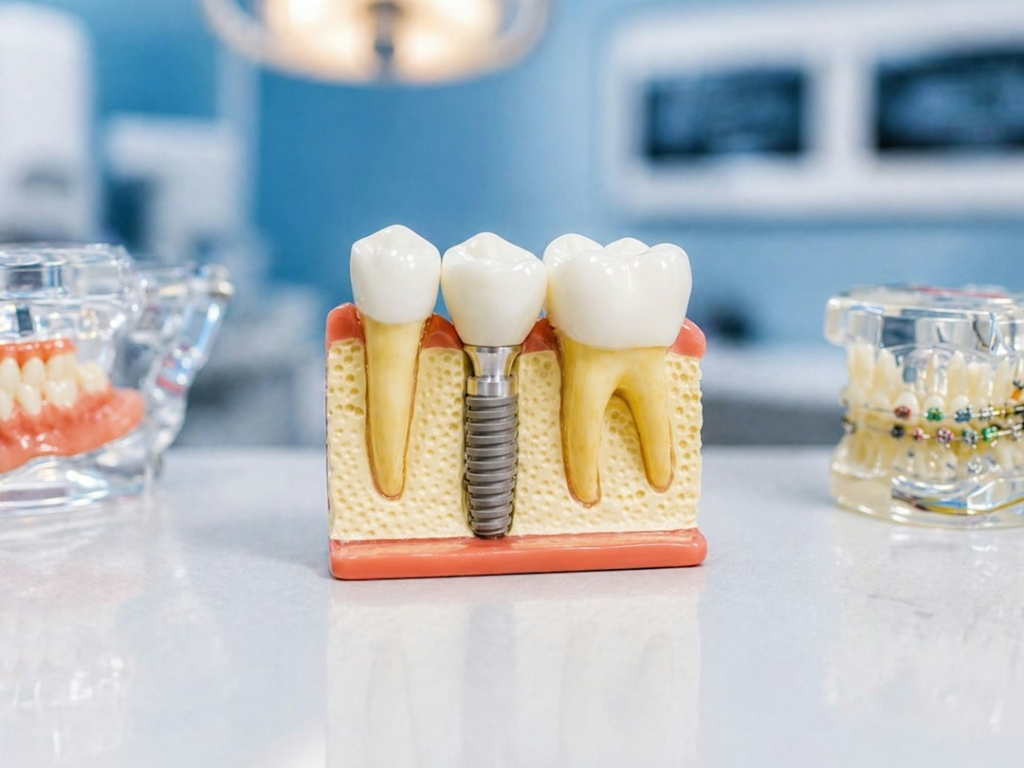
A single implant is a fixture placed in the jawbone to support an abutment and a custom crown. During healing, it integrates with surrounding bone, a process called osseointegration. The crown restores the visible portion of the tooth.
Because the implant has its own support, the teeth on either side usually do not need to be reshaped. However, this is a surgical treatment. Some patients need extraction-site healing or bone or soft-tissue grafting. Not every site has favorable bone or anatomy for straightforward placement.
Our earlier article, The Implant Goes Where the Crown Needs It, explains why the final tooth position should guide planning from the beginning.
How does a dental bridge work?
A traditional tooth-supported bridge uses an artificial tooth, called a pontic, connected to crowns placed on neighboring teeth. Those supporting teeth are shaped for the crowns. The finished restoration is fixed in place, not removed at night.
It can be particularly logical if a tooth on either side already needs a substantial crown. Bridges generally do not require implant surgery.
Not every bridge is a traditional three-unit bridge. A resin-bonded or Maryland bridge may require less tooth preparation in selected situations, but its suitability depends on location, bite, and bonding conditions.
Key differences at a glance
| Question | Single-tooth implant | Traditional fixed bridge |
|---|---|---|
| Support | Independent fixture in the bone | Neighboring teeth |
| Surgery | Required for implant placement | Generally not required for the bridge |
| Timeline | Often months, including healing | Often weeks once teeth are ready |
| Neighboring teeth | Usually remain unprepared | Generally shaped for crowns |
| Cleaning | Around implant crown and gumline | Under pontic and around supporting teeth |
The condition of the supporting teeth and the bone can change the answer considerably.
When I would lean toward an implant
Imagine that a patient has one missing tooth but healthy, intact teeth on both sides. Preparing those healthy teeth simply to support a bridge is a significant commitment. In that situation, an implant may offer the more tooth-preserving design.
It can also be attractive when the goal is an independently supported tooth. But we must confirm adequate space and bone, healthy tissues, and a manageable bite. Tobacco use, poorly controlled diabetes, certain medications, and other medical issues may complicate planning and healing.
Preserving adjacent teeth is valuable; it does not make an implant risk-free or appropriate for everyone.
When a bridge may be smarter
Now imagine the teeth beside the space already have large failing restorations and would benefit from crowns even without a missing tooth. A bridge may address several problems in one plan without implant surgery.
It may also be reasonable if an implant would require extensive grafting, a medical condition makes surgery unsuitable, or a patient prioritizes a shorter sequence. A well-designed bridge can look natural and function very well.
The tradeoff is that the supporting teeth carry the restoration. Decay, fracture, gum problems, or loss of a supporting tooth can affect the entire bridge. Their prognosis deserves careful attention before treatment.
What happens to the bone after tooth loss?
After a natural tooth is lost, the bone that supported its root can change in volume and shape. An implant placed in suitable bone can help maintain bone around it. A conventional bridge replaces the visible tooth without replacing a root in the gap.
Still, no implant guarantees that bone and gums will remain unchanged forever. Extraction technique, grafting, anatomy, and healing influence the result. This is particularly important for front teeth, where subtle changes in gum contours can affect the smile.
Which option lasts longer?
Both can serve patients for many years. I would be cautious about claims such as “a lifetime implant” or “a bridge always fails after ten years.”
An implant fixture may remain stable for decades, but its crown, abutment, or surrounding tissue can need treatment. Implants can develop inflammation or bone loss. Bridges may need repair or replacement due to wear, fracture, decay under a supporting crown, or changes in the bite.
Rather than choosing based on one advertised lifespan, consider what will be healthy and maintainable in your mouth.
How long does treatment take?
A traditional bridge is often completed over a relatively short series of restorative visits. Implant treatment may take months while the implant heals and integrates; extraction healing or grafting can extend the timeline.
Some patients qualify for immediate placement or a provisional tooth, but “teeth in a day” is not suitable for every case. A temporary tooth is not always the final restoration, and chewing restrictions may apply.
Either way, ask how the space will be managed during treatment, particularly if the missing tooth shows when you smile.
What about cost and insurance in Manhattan?
An implant estimate may include examination and imaging, extraction, grafting, surgery, abutment, crown, and follow-up. A bridge quote usually includes supporting crowns and the replacement tooth, plus necessary treatment of those supporting teeth.
Comparing the price of implant surgery alone with a completed bridge is misleading. Ask for an itemized treatment estimate that identifies what is included, what is excluded, and what could change after imaging or healing.
Insurance benefits vary. A plan may cover certain parts of implant treatment or have exclusions, while bridge benefits may differ. Future maintenance or replacement also belongs in the discussion—not only the initial fee.
Our NYC dental implant guide explains the stages of implant care in greater depth.
How do you clean an implant or bridge?
Neither restoration is maintenance-free. A single implant requires cleaning around the crown and gumline, plus professional monitoring. The implant cannot get a cavity, but tissues around it can become inflamed.
A bridge requires cleaning under the pontic and around supporting teeth, often using a floss threader or an interdental brush. Those natural teeth remain vulnerable to decay and gum disease.
Brush twice daily with fluoride toothpaste, clean between teeth, attend examinations, and address grinding or periodontal problems whichever option you choose.
Five questions to ask before deciding
- Are the neighboring teeth healthy, or do they already need crowns?
- Is there enough bone and space for an implant, and would grafting be needed?
- What is the timeline, including temporary teeth and healing?
- What does the full estimate include, and how does insurance apply?
- How will I maintain this restoration over the next decade or two?
A good consultation should clarify why a recommendation makes sense, not just which treatment costs more.
Frequently asked questions
Is an implant always better than a bridge?
No. An implant can preserve healthy neighboring teeth, but a bridge can be an excellent choice when those teeth already need crowns or implant surgery is unsuitable.
Can I get a bridge if I have lost bone?
Possibly. A bridge does not require an implant fixture in the gap, but tissue contours still affect appearance, cleaning, and design. The supporting teeth must also be evaluated.
Does an implant hurt more?
Experiences vary. Implant placement involves surgery with appropriate anesthesia and postoperative care; bridge preparation has a different recovery profile. Your dentist should explain what to expect in your individual case.
Can I leave the gap alone?
Sometimes observation is reasonable. In other cases, neighboring teeth may move or chewing may be affected. The tooth’s location, opposing teeth, function, and long-term goals determine whether replacement is advisable.
The bottom line
Replacing one tooth is not merely choosing between a titanium implant and a porcelain bridge. It is a decision about preserving neighboring teeth, bone, gums, and bite.
At Frangella Dental in Midtown Manhattan, the sensible next step is a complete evaluation and a discussion of options before committing to either approach. The most conservative treatment is the one that fits your anatomy—not necessarily the newest or fastest.
Further patient reading: American Dental Association: Implants and American Academy of Periodontology: Single-Tooth Implants.
