
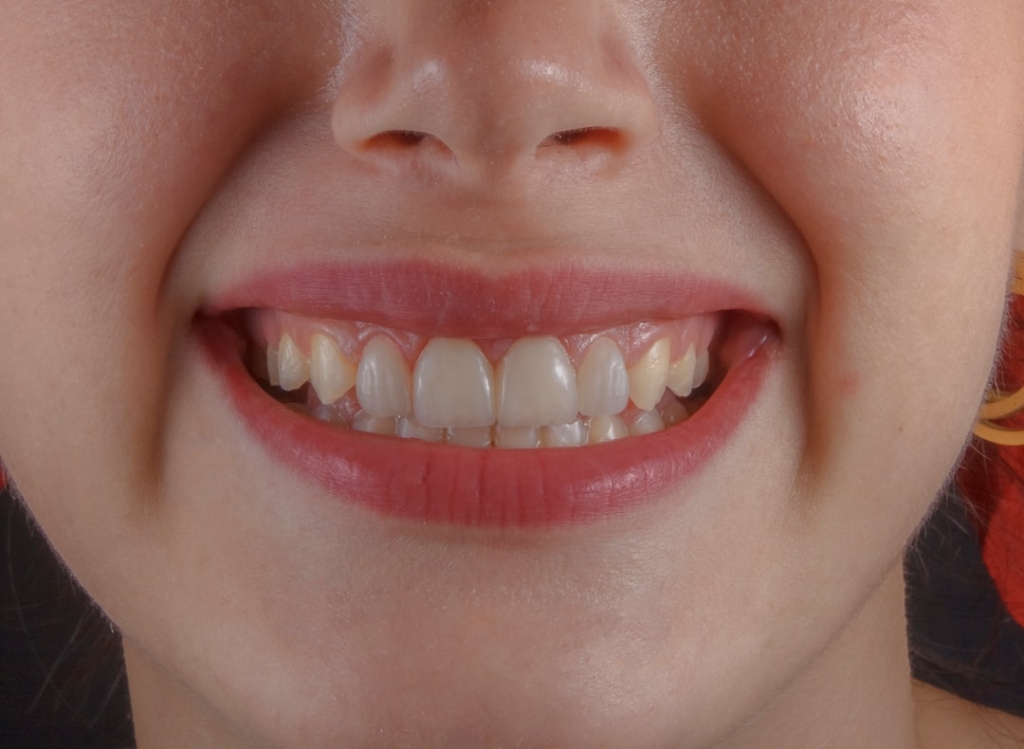
Patients often come in asking a very direct question: Should I do bonding or veneers?
It sounds like a choice between two cosmetic materials. In reality, it is a choice between two very different ways of treating a tooth.
Composite bonding adds tooth-colored resin directly to the existing tooth. Porcelain veneers use a thin ceramic restoration that is bonded to the front of the tooth after careful planning and, in many cases, some enamel preparation.
Both can look excellent. Both can also be the wrong treatment if they are being used to solve the wrong problem.
Here is how I think through the decision when someone wants to improve chipped, worn, uneven, spaced, or discolored front teeth.
Bonding is usually the more conservative starting point
For a small chip, an uneven edge, a modest gap, or one tooth that is slightly out of proportion, bonding can be a very good treatment.
The biggest advantage is conservation. In many cases we can add material without removing much, if any, healthy enamel. The resin is shaped directly on the tooth, hardened, adjusted to the bite, and polished.
That makes bonding especially useful when the underlying tooth is already healthy and attractive but needs a limited correction.
It is also repairable. If a bonded edge chips years later, we can often repair the affected area rather than replacing an entire restoration.
The tradeoff is that composite resin is not porcelain. Over time it can pick up stain, lose some polish, or chip at thin edges. The more material we add, the more those limitations matter.
Veneers are better when the problem is broader
Veneers become more useful when we are trying to change several things at once: color, shape, proportion, surface texture, spacing, and symmetry across multiple teeth.
Porcelain is more color-stable than composite resin and can hold surface gloss extremely well. It also gives the laboratory and dentist more control when we are redesigning a group of teeth rather than fixing one isolated defect.
But a veneer is not automatically a better version of bonding. It is a more involved restorative treatment, and once healthy tooth structure is removed, that decision is not reversible.
That is why the preparation matters so much. Clinical research has consistently shown that ceramic veneers perform best when they can be bonded primarily to enamel rather than deeply prepared dentin. A recent systematic review found the strongest survival and success outcomes when veneers were bonded to enamel. That is one reason conservative planning is not just cosmetic philosophy; it affects longevity.
A chipped tooth is not the same as a worn-down smile
This distinction gets missed online.
If one front tooth has a small traumatic chip, bonding may be all that is needed.
If several front teeth are shortened because of years of grinding, erosion, or an unstable bite, simply adding composite to the edges without understanding the cause can create repeated fractures.
In those cases, the diagnosis comes first. We need to look at the bite, the pattern of wear, the amount of enamel remaining, the position of the teeth, and whether the back teeth are supporting the bite correctly.
Composite can still be very useful for worn teeth. Recent evidence supports it as a conservative option in appropriate cases, particularly for localized anterior wear, but the long-term result depends heavily on case selection and how the bite is managed.
If the teeth are crooked, neither treatment may be the first move
This is where cosmetic dentistry can become unnecessarily aggressive.
If a tooth is significantly rotated or pushed forward, covering the problem with thick bonding or preparing the tooth heavily for a veneer may create a bulky result or require more enamel removal than we would like.
Sometimes a small amount of orthodontic movement first is the most conservative answer. Moving the tooth into a better position can reduce how much restorative material is needed afterward—or eliminate the need for veneers entirely.
That is also why we use digital scans when planning cosmetic cases. The same iTero technology we use for Invisalign and restorative work helps us evaluate tooth position before deciding how much should be added or removed.
What about staining and tooth color?
If the main concern is color, I usually want to know whether whitening can solve the problem before we start covering teeth.
Whitening changes natural enamel. Bonding and porcelain do not whiten after they are placed.
So if someone is considering bonding or veneers and also wants a brighter shade, the sequence matters. Whitening first may allow us to match the restorative material to the final tooth color instead of doing the restorations first and chasing the shade afterward.
For patients comparing options, our guide to in-office versus at-home whitening explains the differences.
How long do bonding and veneers last?
There is no honest single number because longevity depends on the size of the restoration, the bite, grinding habits, diet, oral hygiene, and how much enamel is available for bonding.
In general, composite bonding should be viewed as maintainable rather than permanent. Small bonded areas may last for many years, but polishing, repair, or replacement is normal over time.
Porcelain veneers can have excellent long-term survival when they are carefully planned, conservatively prepared, and well bonded. Long-term studies of enamel-bonded porcelain veneers have reported high survival over a decade, but that should not be translated into a guarantee for every patient or every tooth.
The useful question is not, “Which one lasts forever?” Neither does.
The better question is, “Which treatment gives this tooth the best balance of appearance, durability, and preservation of healthy structure?”
Bonding is usually better when…
- The problem is small and localized.
- You have a minor chip, gap, or uneven edge.
- The underlying tooth color is acceptable.
- We can improve the shape without making the tooth bulky.
- Preserving untouched enamel is the priority.
- You understand that composite may need periodic polishing or repair.
Veneers are usually better when…
- Several front teeth need coordinated changes in shape and proportion.
- Color cannot be predictably corrected with whitening alone.
- There is enough enamel to plan a conservative preparation.
- You want a more color-stable and wear-resistant restorative surface.
- The bite and tooth position make veneers appropriate without aggressive reduction.
And sometimes the right answer is neither
A healthy tooth should not be restored just because we have the ability to restore it.
If whitening solves the problem, whiten. If orthodontics solves the problem, move the tooth. If a tiny chip only needs smoothing, sometimes we simply smooth it.
We recently discussed the opposite end of the spectrum in our article on “Turkey Teeth”, where healthy teeth are sometimes aggressively reduced for full crowns in the name of a fast cosmetic transformation. That is very different from conservative veneer dentistry.
At Frangella Dental, the goal is not to fit every cosmetic concern into the same treatment. It is to use the least invasive option that can predictably accomplish what the patient is asking for.
So: bonding or veneers?
If you have one or two small defects, bonding is often the first option I would want to consider.
If you are changing the color, shape, and proportion of several teeth at the same time, veneers may offer better control and long-term stability.
But the decision should come after we evaluate the teeth—not before. A good cosmetic plan accounts for enamel, bite, tooth position, gum levels, existing restorations, and your expectations before any tooth is altered.
If you want to see the range of problems that can be treated conservatively, our patient gallery includes examples of restorative and cosmetic work completed at Frangella Dental.
Dr. Andrew Frangella provides cosmetic and general dentistry at Frangella Dental in Midtown Manhattan. If you are deciding between bonding, veneers, whitening, or orthodontic treatment, call (212) 245-2888 to schedule a consultation at 200 W. 57th Street, Suite 1405.
