
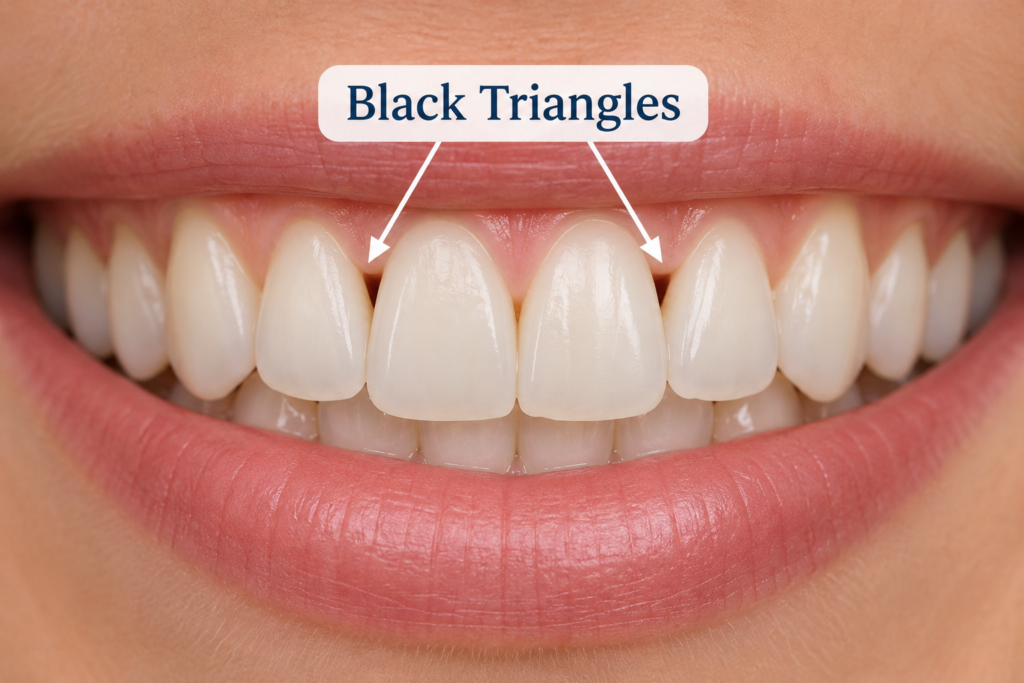
A patient sometimes points to a tiny dark space near the gumline between two front teeth and asks, “Can you just fill that in?” These spaces can be noticeable in photographs, catch food, or appear after teeth have been straightened.
Dentists call them open gingival embrasures. Most people call them black triangles between teeth. The dark area is usually the shadow of an open space where gum tissue does not completely fill the area below the contact between two teeth—not a cavity.
Black triangles can often be improved cosmetically, but the right treatment depends on the cause. A small space between healthy, triangular-shaped teeth is different from one associated with periodontal disease.
What causes black triangles between teeth?
The peak of gum between teeth is called the interdental papilla. Its appearance depends on the supporting bone, tooth shape, root position, and where adjacent teeth touch.
- Triangular tooth shape: Teeth may be wide at their biting edges but narrow toward the gumline, creating a short contact and an opening beneath it.
- Gum recession or periodontal disease: Loss of supporting tissue and bone can lower the papilla.
- Tooth position: Root angulation and crowded or rotated teeth can affect the contact point.
- Changes after orthodontics: Straightening overlapping teeth sometimes reveals a space that was previously hidden.
- Existing restorations: Fillings or crowns with unfavorable contours can contribute to gaps or cleaning difficulties.
Age and individual gum anatomy also play roles. Looking at the triangle alone does not tell us which factor is responsible.
Do black triangles mean you have gum disease?
Not necessarily. A stable, small triangle between otherwise healthy teeth may be mainly cosmetic. A new or enlarging space with bleeding, tenderness, swelling, persistent bad breath, or loose teeth deserves a periodontal examination.
If disease has caused bone or attachment loss, covering the space with cosmetic material does not solve the underlying problem. We need to evaluate and treat the gums before designing a cosmetic restoration.
Sometimes gums look less full after successful periodontal treatment because inflammation and swelling have resolved. That can make a preexisting triangle more visible even though the tissue is healthier.
Can bonding fix black triangles?
For selected teeth, composite bonding is a conservative option. Tooth-colored resin can be added near the sides of the teeth to change the contact shape and reduce the visible opening.
But the goal is not simply to pack material into the gap. The bonding has to look natural, make an appropriate contact, and remain easy to floss and clean. An overcontoured restoration can trap plaque and irritate the gums.
Small triangles caused mainly by tooth shape may respond very well to limited additive bonding. A large space caused by substantial gum or bone loss may not: making the teeth wider can create an unnatural appearance without restoring missing tissue.
Bonding can stain, chip, or need maintenance. That tradeoff may still be reasonable when preserving healthy enamel is the priority. See how long dental bonding lasts for realistic expectations.
Can Invisalign close black triangles?
Sometimes, but aligners are not a universal solution. Tooth movement can change how adjacent teeth contact, which helps certain cases. Results depend on tooth shape, root position, periodontal support, and the orthodontic plan.
For triangular incisors, an orthodontist may consider interproximal reduction (IPR): carefully removing a small amount of enamel between selected teeth so they can be repositioned with a broader contact. IPR must be planned conservatively; enamel removal is irreversible and is not appropriate for everyone.
Invisalign cannot reliably grow back lost bone or gum tissue. Nor should someone straighten otherwise well-positioned teeth solely because a social media video promises that a black triangle will disappear.
Where crowding or bite problems coexist, orthodontic evaluation may help us make a more conservative restorative plan afterward. Read our Invisalign timeline guide to understand why different movements require different treatment times.
Would veneers be better than bonding?
Porcelain veneers can be useful when black triangles are one part of a larger cosmetic concern—for example, multiple teeth with uneven shapes, worn edges, or substantial color differences. Porcelain offers excellent control over shape and shade.
But a veneer is not simply a superior type of bonding. In many cases it involves enamel preparation, more expense, and a long-term commitment to maintaining and possibly replacing the restoration.
For a single small triangle on otherwise healthy teeth, I would first ask whether a less invasive approach could accomplish the goal. Our bonding versus veneers comparison explains the important differences.
Regardless of the material, we cannot sacrifice the health and cleanability of the gumline just to eliminate a visible shadow.
Can gum grafting replace the missing tissue?
In certain cases, a periodontist may evaluate surgery or other soft-tissue procedures. Reconstructing the tiny papilla between teeth is technically difficult, however, and outcomes are not reliably predictable.
A 2024 systematic review on interdental papilla reconstruction examined several surgical and nonsurgical techniques but found studies too different for a reliable pooled estimate of effectiveness. This is not a treatment for which anyone should promise complete, permanent regrowth.
Sometimes periodontal treatment, tooth movement, and carefully designed restorative work are combined. Sometimes the most sensible choice is simply to monitor a stable space.
What happens during an evaluation at Frangella Dental?
I begin with the basics: Is this an opening underneath a tooth contact, or a broader gap between teeth? Has it changed recently? Are the gums healthy? Do tooth shape, root position, or an old restoration explain the appearance?
We assess the bite and tooth contacts, examine the gumline, and take periodontal measurements and radiographs when indicated. Photographs and digital scans can help visualize shapes and plan treatment. Our explanation of iTero scanning at Frangella Dental shows how that technology supports selected cases; it does not replace a clinical examination.
Just as important, I ask what is bothering the patient. Is the problem appearance, food trapping, a recent change, or concern about gum health? That answer often determines whether any cosmetic treatment is worthwhile.
How much does black triangle treatment cost in NYC?
There is no honest single price for “fixing black triangles,” because that can mean simple composite bonding, orthodontics, veneers, periodontal treatment, or nothing at all.
A useful quote should identify which teeth need work, whether healthy enamel must be removed, what maintenance to expect, and whether complete closure is realistic. Comparing the scope of care is more valuable than comparing an isolated advertised fee.
At Frangella Dental, the objective is not the largest treatment plan. It is the least invasive appropriate solution that addresses the actual cause.
Can you get rid of black triangles at home?
Gentle brushing and appropriate interdental cleaning protect gum health, but home remedies cannot reliably regenerate lost bone or papilla tissue. Avoid forcing floss or objects into the space in an attempt to push the gum upward.
If food repeatedly gets trapped, the gap enlarges, the gums bleed, or a tooth becomes loose, arrange a dental evaluation rather than treating it as merely cosmetic.
Frequently asked questions
Will a black triangle close on its own?
Persistent spaces related to tooth shape or established tissue loss usually do not close spontaneously. Temporary tissue changes may affect appearance, but the underlying cause matters.
Is a black triangle the same as a gap between teeth?
No. A diastema is a broader separation between teeth. A black triangle is specifically an opening close to the gumline beneath or around a contact.
Can dental bonding fix it in one appointment?
Some small cases can be treated in one visit after a proper examination. More complex cases may require gum treatment or orthodontic planning first.
Do black triangles always happen after Invisalign?
No. They sometimes become visible after alignment because of existing tooth shape and gum anatomy. They are a potential consideration, not an inevitable outcome.
Does cosmetic treatment cure gum disease?
No. Improving the appearance does not replace periodontal treatment, and any restoration must remain easy to clean.
The bottom line
Black triangles between teeth have several causes and several possible solutions. Bonding may be ideal for a small shape-related opening, Invisalign may help selected alignment problems, veneers can serve broader cosmetic needs, and gum health must come first when disease is present.
The right sequence is diagnosis, gum health, and only then cosmetic planning. If a space has appeared or begun to bother you, an examination at Frangella Dental in Midtown Manhattan can clarify the options without committing you to unnecessary treatment.
Clinical reading: Interdisciplinary Management of Open Interproximal Embrasures (2025); Interdental Papilla Reconstruction: A Systematic Review (2024).
Illustrative featured photography: Caroline LM / Unsplash. Not a Frangella Dental patient or before-and-after photograph.
